Question
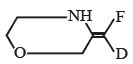
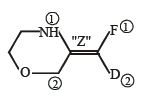
Configuration of the following compound is
Answer

d

Need a full question paper?

Generate a complete, print-ready paper with questions like this in minutes — across 16+ boards, with answer keys.

Start Generating Free

Similar questions

The energy of an electron in the first Bohr’s orbit of $H$ atom is $-13.6\,eV.$ The possible energy value (s) of the excited state (s) for electron in Bohr’s orbits of hydrogen is (are) : ............. $\mathrm{eV}$
An equilibrium shift towards reactants at higher temperatures. Find the correct graph
Given below are two statements: One is labelled as Assertion ($A$) and the other is labelled as Reason ($R$)

Assertion ($A$): Enthalpy of neutralisation of strong monobasic acid with strong monoacidic base is always $-57 \mathrm{~kJ} \mathrm{~mol}^{-1}$

Reason ($R$): Enthalpy of neutralisation is the amount of heat liberated when one mole of $\mathrm{H}^{+}$ions furnished by acid combine with one mole of ${ }^{-} \mathrm{OH}$ ions furnished by base to form one mole of water. In the light of the above statements, choose the correct answer from the options given below.

Which of the following are redox changes?
$(i)$ Hydrolysis of $XeF_2$
$(ii)$ Thermal decomposition of $Ag_2CO_3$
$(iii)$ Reaction of $Al$ with $NaOH$
$(iv)$ Hydrolysis Of $PCl_5$
$(v)$ Reaction of NaCl with conc. $H_2SO_4$
Correct options are
The decomposition of formic acid on gold surface follows first order kinetics. If the rate constant at $300\, K$ is $1.0 \times 10^{-3} s ^{-1}$ and the activation energy $E _{ a }=11.488\, kJ\, mol ^{-1},$ the rate constant at $200\, K$ is ............  $\quad \times 10^{-5} s ^{-1} .$

(Round of to the Nearest Integer).

(Given : $\left. R =8.314\, J\, mol ^{-1} K ^{-1}\right)$

A mixture of benzaldehyde and formaldehyde on heating with aqueous $NaOH$ solution gives :-
The final acid obtained during the manufacture of ${H_2}S{O_4}$ by contact process is
Which of the following exhibits highest solubility in water
Hydrocarbon ${C_6}{H_6}$ decolourise $B{r_2}$ water and gives ppt. with ammonical $AgN{O_3}$ Hydrocarbon can be
The de Broglie wavelength of an electron in the $4^{th}$ Bohr orbit is