MCQ
Conservation of momentum in a collision between particles can be understood from:
  • A
    Conservation of energy.
  • B
    Newton’s first law only.
  • C
    Newton’s second law only.
  • Both Newton’s second and third law.

Answer

Correct option: D.
Both Newton’s second and third law.
  1. By newton's second law $\frac{\vec{\text{dp}}}{\text{dt}}=\vec{\text{f}}_\text{ext}$
As $\vec{\text{F}}_\text{ext}$ on law of conservation of momentam is zero.
$\text{i.e},\vec{\text{f}}_\text{ext}=0$
$\frac{\vec{\text{dp}}}{\text{dt}}=0$
$\Rightarrow\vec{\text{p}}$ is constant.
  1. By netton's third law action force is equal to reaction force in magnitude but in opposite direction.
$\therefore\vec{\text{F}}_12=-\vec{\text{F}}_21(\vec{\text{F}_\text{ext}}=0)$
$\frac{\vec{\text{dp}_{12}}}{\text{dt}}=\frac{\vec{\text{- dp}_{21}}}{\text{dt}}$ or $\vec{\text{dp}_{12}}=-\vec{\text{dp}_{21}}$
$\vec{\text{dp}}_{12}+\vec{\text{dp}_{21}}=0.$

Need a full question paper?

Generate a complete, print-ready paper with questions like this in minutes — across 16+ boards, with answer keys.
Start Generating Free

Similar questions

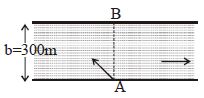
A river is flowing with velocity $5\ km/hr$ as shown in the figure. A boat starts from $A$ and reaches the other bank by covering shortest possible distance . Velocity of boat in still water is $3\ km/ hr$. The distance boat covers is    ......... $m$
A swimmer swims in still water at a speed $= 5\,\, km/hr$. He enters a $200\,\, m$ wide river, having river flow speed $= 4\,\, km/hr$ at point A and proceeds to swim at an angle of $127^o$ (sin $37^o = 0.6$) with the river flow direction.Another point $B$ is located directly across Aon the other side. The swimmer lands on the other bank at a point $C$, from which he walks the distance $CB$ with a speed $= 3\,\, km/hr.$ The total time in which he reachrs from $A$ to $B$ is..........$minutes$
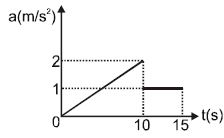
A particle starts from rest and undergoes an acceleration as shown in figure. The  velocity-time graph from figure will have shape.
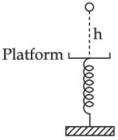
A ball of mass $100 \,g$ is dropped from a height $h =$ $10\, cm$ on a platform fixed at the top of vertical spring (as shown in figure). The ball stays on the platform and the platform is depressed by a distance $\frac{ h }{2}$. The spring constant is.......... $Nm^{-1}$ . (Use $g=10\, ms ^{-2}$ )
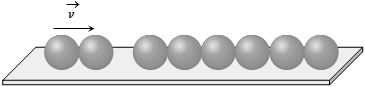
Six identical balls are lined in a straight groove made on a horizontal frictionless surface as shown. Two similar balls each moving with a velocity $v$ collide elastically with the row of $6$ balls from left. What will happen
Given below are two statements: One is labelled as Assertion $(A)$ and other is labelled as Reason $(R)$.

Assertion $(A)$ : Time period of oscillation of a liquid drop depends on surface tension $(S)$, if density of the liquid is $p$ and radius of the drop is $r$, then $T = k \sqrt{ pr ^{3} / s ^{3 / 2}}$ is dimensionally correct, where $K$ is dimensionless.

Reason $(R)$: Using dimensional analysis we get $R.H.S.$ having different dimension than that of time period.

In the light of above statements, choose the correct answer from the options given below.
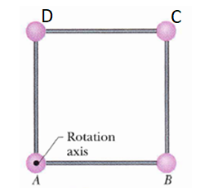
Four particles of equal masses are placed on the vertices of a square and are rotated with a uniform angular velocity about one of the edges $(A)$ as shown in the figure. Which particle will have a larger angular momentum:
Ratio between maximum range and square of time of flight in projectile motion is
On all the six surfaces of a unit cube, equal tensile force of $F$ is applied. The increase in length of each side will be ($Y =$ Young's modulus, $\sigma $= Poission's ratio)
The ratio of the volume of the atom to the volume of the nucleus is of the order of: