Question
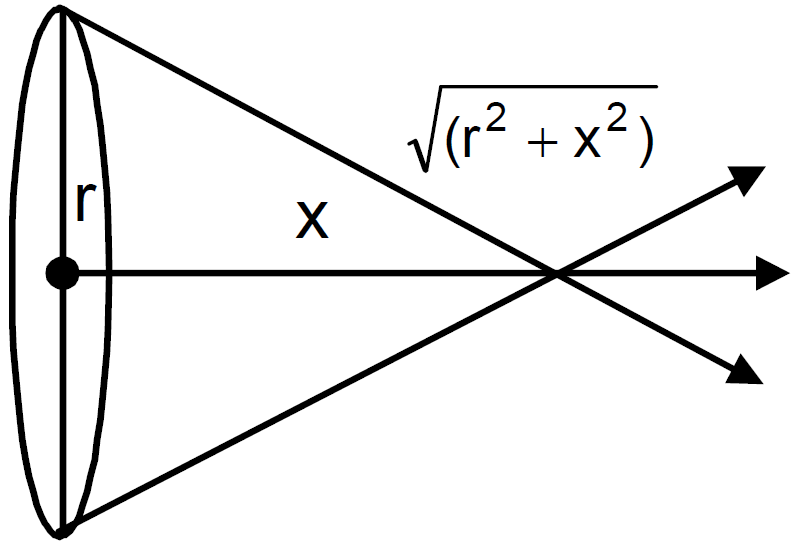
Consider a circular ring of radius r, uniformly charged with linear charge density $\lambda.$ Find the electric potential at a point on the axis at a distance x from the centre of the ring. Using this expression for the potential, find the electric field at this point.
Answer


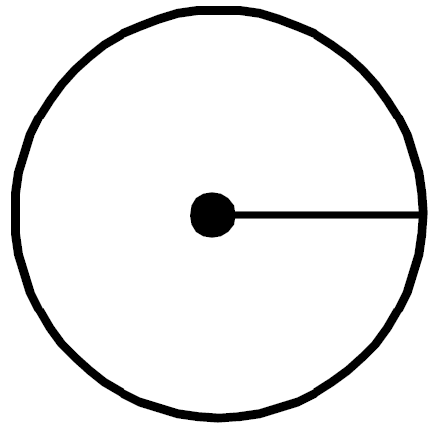
Radius = r
So, $2\pi\text{r}=$ Circumference
Charge density $=\lambda$
Total charge $=2\pi\text{r}\times\lambda$
Electric potential $=\frac{\text{Kq}}{\text{r}}$
$=\frac{1}{4\pi\in_0}\times\frac{2\pi\text{r}\lambda}{\big(\text{x}^2+\text{r}2\big)^{\frac{1}{2}}}$
$=\frac{\text{r}\lambda}{2\in_0\big(\text{x}^2+\text{r}^2\big)^{\frac{1}{2}}}$

So, Electric field $=\frac{\text{V}}{\text{r}}\cos\theta$
$=\frac{\text{r}\lambda}{2\in_0\big(\text{x}^2+\text{r}^2\big)^{\frac{1}{2}}}\times\frac{\text{x}}{\big(\text{x}^2+\text{r}^2\big)^{\frac{1}{2}}}$
$=\frac{\text{r}\lambda\text{x}}{2\in_0\big(\text{x}^2+\text{r}^2\big)^{\frac{3}{2}}}$

Need a full question paper?

Generate a complete, print-ready paper with questions like this in minutes — across 16+ boards, with answer keys.

Start Generating Free

Similar questions

Two identical pith balls are charged by rubbing against each other. They are suspended from a horizontal rod through two strings of length 20cm each, the separation between the suspension points being 5cm. In equilibrium, the separation between the balls is 3cm. Find the mass of each ball and the tension in the strings. The charge on each ball has a magnitude $2.0 \times 10^{-8}C.$
Suppose the ends of the coil in the previous problem are connected to a resistance of $100\Omega.$ Neglecting the reaiatance of the coil, find the heat produced in the circuit in one minute.
A rectangular loop of sides 20cm and 10cm carries a current of 5.0A. A uniform magnetic field of magnitude 0.20T exists parallel to the longer side of the loop.
  1. What is the force acting on the loop?
  2. What is the torque acting on the loop?
Find the wavelength of the radiation emitted by hydrogen in the transitions (a) n = 3 to n= 2, (b) n = 5 to n = 4 and (c) n = 10 to n = 9.
Find the mass, the kinetic energy and the momentum of an electron moving at O.8c.
Consider a straight piece of length x of a wire carrying a current i. Let P be a point on the perpendicular bisector of the piece, situated at a distance d from its middle point. Show that for d >> x, the magnetic field at P varies as $\frac{1}{\text{d}^2}$ whereas ford d << x, it varies as $\frac{1}{\text{d}}.$
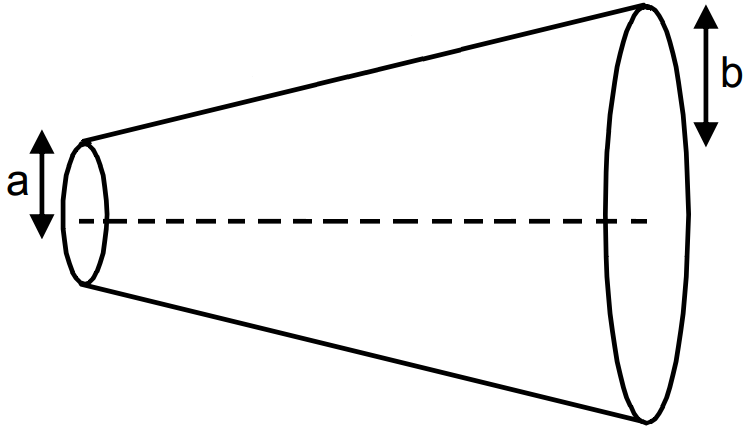
Figure. shows a conductor of length l with a circular cross-section. The radius of the cross-section varies linearly from a to b. The resistivity of the material is ρ. Assuming that b - a << l, find the resistance of the conductor.
A beam of monochromatic light of wavelength $\lambda$ ejects photoelectrons from a cesium surface $\big(\Phi=1.9\text{eV}\big).$ These photoelectrons are made to collide with hydrogen atoms in ground state. Find the maximum value of $\lambda$ for which (a) hydrogen atoms may be ionized, (b) hydrogen atoms may get excited from the ground state to the first excited state and (c) the excited hydrogen atoms may emit visible light.
A uniform field of $2.0NC^{-1}$ exists in space in x-direction.
  1. Taking the potential at the origin to be zero, write an expression for the potential at a general point (x, y, z).
  2. At which points, the potential is 25V?
  3. If the potential at the origin is taken to be 100V, what will be the expression for the potential at a general point?
  4. What will be the potential at the origin if the potential at infinity is taken to be zero? Is it practical to choose the potential at infinity to be zero?
Write the definition of electric capacitance. A parallel plate capacitor is filled with a medium of dielectric constant K between the plates. Find the expression of its capacitance. Draw the necessary diagram.