Question
Consider a heavy string X and a light string Y joined together at point O. Explain what happens when a wave pulse
(1) travelling from the string X reaches the junction O
(2) travelling from the string Y reaches the junction O.
Answer

Get the step-by-step solution for this question inside the Vidyadip app.

Get the answer in the app

Need a full question paper?

Generate a complete, print-ready paper with questions like this in minutes — across 16+ boards, with answer keys.

Start Generating Free

Similar questions

Explain the thermodynamics of the isochoric process.
A solid cylinder, of mass $2 \mathrm{~kg}$ and radius $0.1 \mathrm{~m}$, rolls down an inclined plane of height $3 \mathrm{~m}$. Calculate its rotational energy when it reaches the foot of the plane.
State and explain the laws of vibrating strings.
A proton is to be suspended in vacuum between two parallel plates separated by $1 mm$. Find (i) the electric field required (ii) the potential difference between the plates corresponding to the desired field. $\left[m_p=1.67 \times 10^{-27} kg\right.$ ]
Derive the conditions for bright and dark fringes produced due to diffraction by a single slit.
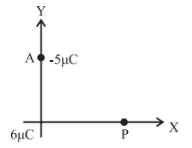
A charge $6 \mu C$ is placed at the origin and another charge $-5 \mu C$ is placed on the y axis at a position $A (0, 6.0)$ m.
Image
(a) Calculate the total electric potential at the point P whose coordinates are $(8.0, 0)$ m
(b) Calculate the work done to bring a proton from infinity to the point P. What is the significance of the sign of the work done ?
Explain the effect of a dielectric on the capacitance of a isolated charged parallel-plate capacitor.
Hence, show that if a dielectric of relative permit-tivity (dielectric constant) $k$ completely fills the space between the plates, the capacitance increases by a factor $k$.
Obtain an expression for wavenumber, when an electron jumps from a higher energy orbit to a lower energy orbit. Hence show that the shortest wavelength for the Balmar series is $4/R_H$​​​​​​​.
Explain
(1) free vibrations
(2) forced vibrations.
Explain the linear velocity of a particle performing circular motion.
OR
Derive the relation between the linear velocity and the angular velocity of a particle performing circular motion.