- With greater average speed.
- With smaller average speed.
- With greater average kinetic energy.
- With smaller average kinetic energy.
Explanation:
The average speed of molecules is given by $\sqrt{\frac{8\text{kT}}{\pi\text{m}}}.$
We observe that greater the mass, lesser is the average speed of the molecule. Since an oxygen molecule is heavier than a hydrogen molecule, the oxygen molecule will hit the wall with smaller average speed.
Generate a complete, print-ready paper with questions like this in minutes — across 16+ boards, with answer keys.
A short magnet oscillates with a time period 0.1 s at a place where horizontal magnetic field is 24μT. A downward current of 18 A is established in a vertical wire 20 cm east of the magnet. The new time period of oscillator
|
(a) 0.1 s |
(b) 0.089 s |
(c) 0.076 s |
(d) 0.057 s |
Kirchhoff's first law i.e. at a junction is based on the law of conservation of
|
(a) Charge |
(b) Energy |
(c) Momentum |
(d) Angular momentum |
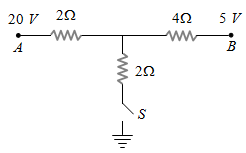
As the switch S is closed in the circuit shown in figure, current passed through it is

|
(a) 4.5 A |
(b) 6.0 A |
(c) 3.0 A |
(d) Zero |
The velocity of light in a medium is half its velocity in air. If ray of light emerges from such a medium into air, the angle of incidence, at which it will be totally internally reflected, is
|
(a) 15o |
(b) 30 o |
(c) 45 o |
(d) 60 o |
The energy gap of silicon is 1.14 eV. The maximum wavelength at which silicon will begin absorbing energy is
|
(a) 10888 Å |
(b) 1088.8 Å |
(c) 108.88 Å |
(d) 10.888 Å |