MCQ
Consider a mixture of oxygen and hydrogen kept at room temperature. $AB$ compared to a hydrogen molecule an oxygen molecule hits the wall:
  • A
    With greater average speed.
  • With smaller average speed.
  • C
    With greater average kinetic energy.
  • D
    With smaller average kinetic energy.

Answer

Correct option: B.
With smaller average speed.
The average speed of molecules is given by $\sqrt{\frac{8\text{kT}}{\pi\text{m}}}.$
We observe that greater the mass, lesser is the average speed of the molecule. Since an oxygen molecule is heavier than a hydrogen molecule, the oxygen molecule will hit the wall with smaller average speed.

Need a full question paper?

Generate a complete, print-ready paper with questions like this in minutes — across 16+ boards, with answer keys.

Start Generating Free

Similar questions

Two bodies at different temperatures are mixed in a calorimeter. Which of the following quantities remains conserved?
A plastic circular disc of radius $R$ is placed on a thin oil film, spread over a flat horizontal surface. The torque required to spin the disc about its central vertical axis with a constant angular velocity is proportional to
A body cools in $7$ minutes from $60^{\circ}\,C$ to $40^{\circ}\,C$. The temperature of the surrounding is $10^{\circ}\,C$. The temperature of the body after the next $7$ minutes will be
A body of mass $50\, kg$ is projected vertically upwards with velocity of $100 \,m/sec$. $5 \,seconds$ after this body breaks into $20\, kg$ and $30 \,kg$. If $20\, kg $ piece travels upwards with $150 \,m/sec$, then the velocity of other block will be
Three moles of an ideal gas $\left( {{C_P} = \frac{7}{2}R} \right)$ at pressure ${P_A}$ and temperature ${T_A}0$ is isothermally expanded to twice its initial volume. It is then compressed at constant pressure to its original volume. Finally the gas is compressed at constant volume to its original pressure ${P_A}.$ The correct $P-V$ and $P-T$ diagrams indicating the process are
From the top of a tower of height $40m,$ a ball is projected upwards with a speed of $20\ m/ s$ at an angle of elevation of $30^\circ .$ The ratio of the total time taken by the ball to hit the ground to its time of flight time taken to come back to the same elevation is $($Take $g = 10\ m/ s^2)$
There are two bodies of masses $100\, kg$ and $10000\, kg $ separated by a distance $1\, m$.  At what distance from the smaller body, the intensity of gravitational field will be zero
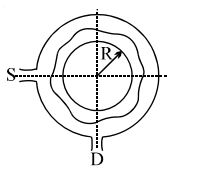
A narrow tube is bent in the form of a circle of radius $R,$ as shown in the figure. Two small holes $S$ and $D$ are made in the tube at the positions right angle to each other. A source placed at $S$ generated a wave of intensity $I_0$ which is equally divided into two parts : One part travels along the longer path, while the other travels along the shorter path. Both the part waves meet at the point $D$ where a detector is placed  The maximum value of $\lambda$ to produce a maxima at $D$ is given by
A force vector applied on a mass is represented as $\vec F = 6\hat i - 8\hat j + 10\hat k$ and accelerates with $1\;m/{s^2}$. What will be the mass of the body in $kg$.
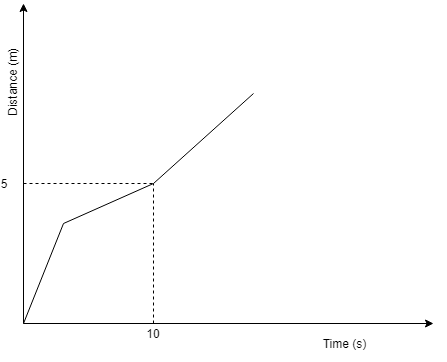
What is the velocity for a body following the graph below at $10s?$