Question
Consider a p-n junction diode having the characteristic $\text{i}-\text{i}_0\Big(\text{e}^{\frac{\text{eV}}{\text{kT}}}-1\Big)$ where $\text{i}_0=20\mu\text{A}.$ The diode is operated at T = 300K.
  1. Find the current through the diode when a voltage of 300mV is applied across it in forward bias.
  2. At what voltage does the current double?
Answer

  1. $\text{i}_0=20\times10^{-6}\text{A},\ \text{T}=300\text{K, V}=300\text{mV}$
$\text{i}=\text{i}_0\text{e}^{\frac{\text{eV}}{\text{KT}}-1}$ $=20\times10^{-6}\Big(\text{e}^{\frac{100}{8.62}}-1\Big)=2.18\text{A}=2\text{A}.$
  1. $4=20\times10^{-6}\Big(\text{e}^{\frac{\text{V}}{8.62\times3\times10^{-2}}}-1\Big)$
$\Rightarrow\text{e}^{\frac{\text{V}\times10^3}{8.62\times3}}-1=\frac{4\times10^6}{20}$

$\Rightarrow\text{e}^{\frac{\text{V}\times10^3}{8.62\times3}}=200001\Rightarrow\frac{\text{V}\times10^{3}}{8.62\times3}=12.2060$

$\Rightarrow\text{V}=315\text{mV}=318\text{mV}.$

Need a full question paper?

Generate a complete, print-ready paper with questions like this in minutes — across 16+ boards, with answer keys.

Start Generating Free

Similar questions

Two cells of emf 1V, 2V and internal resistances $2\Omega$ and $1\Omega$ respectively are connected in (i) series. (ii) Parallel. What should be the external resistance in the circuit so that the current through the resistance be the same in the two cases? In which case is more heat generated in the cells?
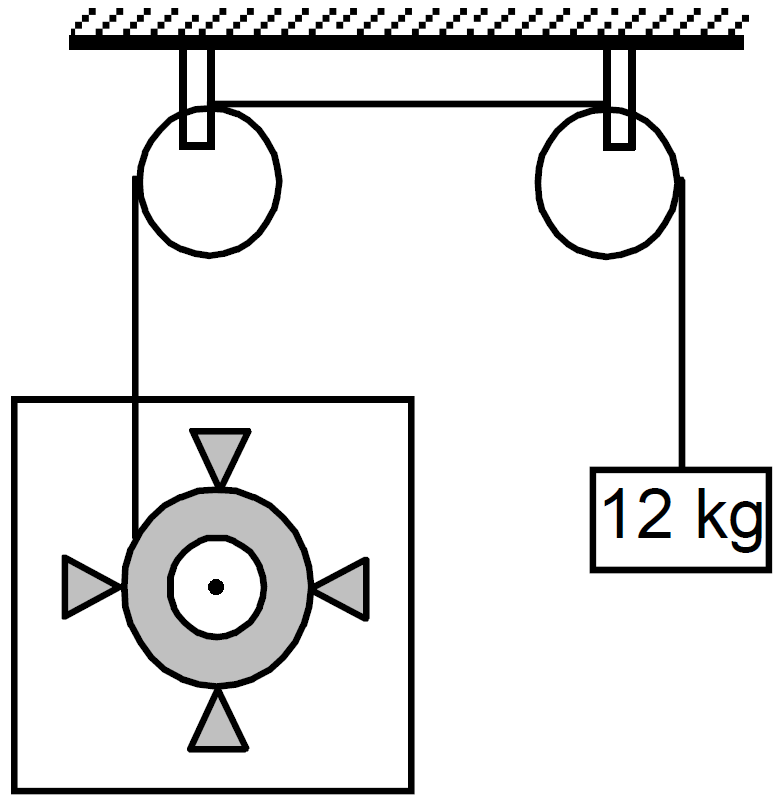
Figure. shows a paddle wheel coupled to a mass of 12kg through fixed frictionless pulleys. The paddle is immersed in a liquid of heat capacity $4200JK^{-1}$ kept in an adiabatic container. Consider a time interval in which the 12kg block falls slowly through 70cm.
  1. How much heat is given to the liquid?
  2. How much work is done on the liquid?
  3. Calculate the rise in the temperature of the liquid neglecting the heat capacity of the container and the paddle.
Two vessels A and B of equal volume $V_0$ are connected by a narrow tube that can be closed by a valve. The vessels are fitted with pistons that can be moved to change the volumes. Initially, the valve is open and the vessels contain an ideal gas $\Big(\frac{\text{C}_\text{P}}{\text{C}_\text{V}}=\gamma\Big)$ at atmospheric pressure $p_0$ and atmospheric temperature $T_0$. The walls of vessel A are diathermic and those of B are adiabatic. The valve is now closed and the pistons are slowly pulled out to increase the volumes of the vessels to double the original value.
  1. Find the temperatures and pressures in the two vessels.
  2. The valve is now opened for sufficient time so that the gases acquire a common temperature and pressure. Find the new values of the temperature and pressure.
A charged particle oscillates about its mean equilibrium position with a frequency of $10^9 $ Hz. What is the frequency of the electromagnetic waves produced by the oscillator?
A magnetic field of $(4.0\times10^{-3}\vec{\text{k}})$ T exerts a force of $(4.0\vec{\text{i}}+3.0\vec{\text{j}})\times10^{-10}$ N on a particle with a charge of $1.0\times10^{-9}\text{C}$ and going in the x−y plane. Find the velocity of the particle.
Two balls having masses m and 2m are fastened to two light strings of same length (l). The other ends of the strings are fixed at O. The strings are kept in the same horizontal line and the system is released from rest. The collision between the balls is elastic.
  1. Find the velocities of the balls just after their collision.
  2. How high will the balls rise after the collision?
A rod of negligible heat cafacity has length 20cm, area of cross section 1.0cm and thermal conductivity ${200Wm^{-1}}^\circ C^{-1}$. The temperature of one end is maintained at 0°C and that of the other end is slowly and linearly varied from 0°C to 60°C in 10 minutes. Assuming no loss of heat through the sides, find the total heat transmitted through the rod in these 10 minutes.
  1. Differentiate between three segments of a transistor on the basis of their size and level of doping.
  2. How is a transistor biased to be in active state?
  3. With the help of necessary circuit diagram, describe briefly how n-p-n transistor in CE configuration amplifies a small sinusoidal input voltage. Write the expression for the ac current gain.
Write first and second postulates of Bohr's Atomic Model. Obtain the expression for radius and velocity of stable orbit of electron.###Explain Bohr's two postulates for hydrogen atom.
The $\text{K}_\alpha$ X-rays of aluminium (Z = 13) and zinc (Z = 30) have wavelengths 887pm and 146pm respectively. Use Moseley's law $\sqrt{\text{v}}=\text{a}(\text{z-b})$ to find the wavelengths of the $\text{K}_\alpha$ X-ray of iron (Z = 26).
