MCQ
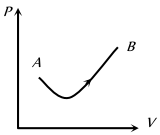
Consider a process shown in the figure. During this process the work done by the system
Image

  • Continuously increases
  • B
    Continuously decreases
  • C
    First increases, then decreases
  • D
    First decreases, then increases

Answer

Correct option: A.
Continuously increases
(a) As the volume is continuously increasing and the work of expansion is always positive, so the work done by the system continuously increases.

Need a full question paper?

Generate a complete, print-ready paper with questions like this in minutes — across 16+ boards, with answer keys.
Start Generating Free

Similar questions

The mass of a planet that has a moon whose time period and orbital radius are $T$ and $R$ respectively can be written as
There is a current of $1.344 \mathrm{amp}$ in a copper wire whose area of cross-section normal to the length of the wire is $1 \mathrm{~mm}^2$. If the number of free electrons per $\mathrm{cm}^3$ is $8.4 \times 10^{22}$, then the drift velocity would be
If $\lambda=10 \mathring A$, then it corresponds to
With a potentiometer null point were obtained at $140 \mathrm{~cm}$ and 180 cm with cells of emf $1.1 \mathrm{~V}$ and one unknown $X$ volts. Unknown emf is
The stationary wave $y=2 a \sin k x \cos \omega t$ in a closed organ pipe is the result of the superposition of $y=a \sin (\omega t-k x)$ and
A steady current of 5 amps is maintained for 45 mins. During this time it deposits $4.572 gms$ of zinc at the cathode of a voltameter. E.C.E. of zinc is
The power of pump, which can pump $200 \mathrm{~kg}$ of water to a height of $50 \mathrm{~m}$ in $10 \mathrm{sec}$, will be
A body is at rest under the action of three forces, two of which are $\vec{F}_1=4 \hat{i}, \vec{F}_2=6 \hat{j}$, the third force is
The plots of intensity versus wavelength for three black bodies at temperatures $T, T$ and $T$ respectively are as shown. Their temperature are such that

Image

In an electrolyte $3.2 \times 10^{18}$ bivalent positive ions drift to the right per second while $3.6 \times 10^{18}$ monovalent negative ions drift to the left per second. Then the current is