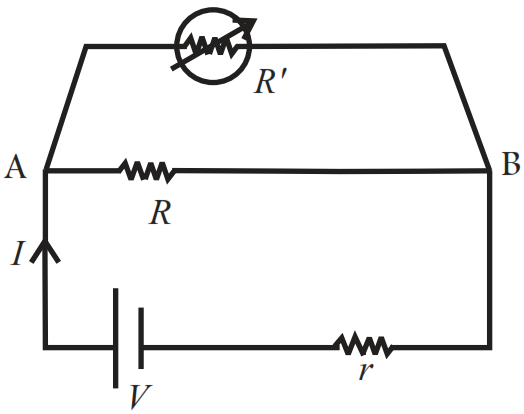
- APotential drop across AB is nearly constant as R' is varied.
- BCurrent through R' is nearly a constant as R' is varied.
- CCurrent I depends sensitively on R'.
- D$\text{I}\geq\frac{\text{V}}{\text{r}+\text{R}}$ always.
Solution:
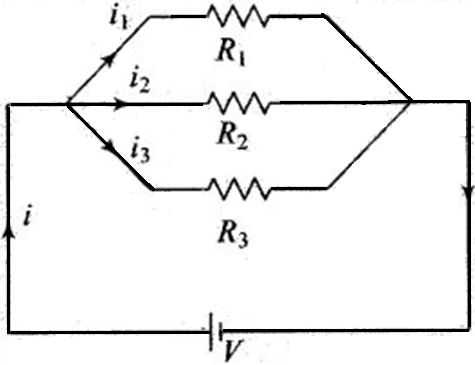
Key concept: Parallel grouping

Same potential difference appeared across each resistance but current distributes in the reverse ration of their resistance, i.e. $\text{i}\propto\frac{\text{l}}{\text{R}}$
In this problem, the potential drop is taking place across AB and r. Since the equivalent resistance of parallel combination of R and R' is always less than R, therefore current will be greater than or equal to $\text{I}\geq\frac{\text{V}}{\text{r}+\text{R}}$ always.
Important poin: in parallel combination of resistances, the equivalent resistance is smaller than smallest resistance present in combination.
Generate a complete, print-ready paper with questions like this in minutes — across 16+ boards, with answer keys.
The characteristic X-ray radiation is emitted, when
| (a) The electrons are accelerated to a fixed energy |
| (b) The source of electrons emits a monoenergetic beam |
|
(c) The bombarding electrons knock out electrons from the inner shell of the target atoms and one of the outer electrons falls into this vacancy |
|
(d) The valence electrons in the target atoms are removed as a result of the collision |
Wave nature of light follows because
|
(a) Light rays travel in a straight line |
|
(b) Light exhibits the phenomena of reflection and refraction |
|
(c) Light exhibits the phenomenon of interference |
|
(d) Light causes the phenomenon of photoelectric effect |
A circular loop of radius R carrying current I lies in x-y plane with its centre at origin. The total magnetic flux through x-y plane is
|
(a) Directly proportional to I |
(b) Directly proportional to R |
|
(c) Directly proportional to |
(d) Zero |
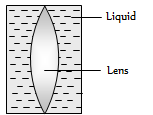
Shown in the figure here is a convergent lens placed inside a cell filled with a liquid. The lens has focal length + 20 cm when in air and its material has refractive index 1.50. If the liquid has refractive index 1.60, the focal length of the system is

|
(a) + 80 cm |
(b) – 80 cm |
(c) – 24 cm |
(d) –100 cm |