Question
Consider a simple pendulum, having a bob attached to a string, that oscillates under the action of the force of gravity. Suppose that the period
of oscillation of the simple pendulum depends on its length $(l),$ mass of the bob $(m)$ and acceleration due to gravity $(g)$. Derive the expression for its time period using method of dimensions.
Answer

The dependence of time period $T$ on the quantities $l, g$ and $m$ as a product may be written as :
$T=k P^r g^y m^z$
where $k$ is dimensionless constant and $x, y$ and $z$ are the exponents.
By considering dimensions on both sides, we have
${\left[ L ^0 M ^0 T ^1\right]=\left[ L ^1\right]^x\left[ L ^1 T ^{-2}\right]^y\left[ M ^1\right]^z}$
$= L ^{x \neq y} T ^{2 y} M ^z$
On equating the dimensions on both sides, we have
$x+y=0 ;-2 y=1 \text {; and } z=0$
So that $x=\frac{1}{2}, y=-\frac{1}{2}, z=0$
Then, $T=k\ l^\frac{1}{2} g^\frac{1}{2}$
or, $T=k \sqrt{\frac{l}{g}}$
Note that value of constant $k$ can not be obtained by the method of dimensions.
Here it does not matter if some number multiplies the right side of this formula,
because that does not affect its dimensions.
Actually, $k=2 \pi$ so that $T=2 \pi \sqrt{\frac{l}{g}}$

Need a full question paper?

Generate a complete, print-ready paper with questions like this in minutes — across 16+ boards, with answer keys.

Start Generating Free

Similar questions

The band gap for silicon is $1.1eV.$
  1. Find the ratio of the band gap to $kT$ for silicon at room temperature $300K.$
  2. At what temperature does this ratio become one tenth of the value at $300K?$
$($Silicon will not retain its structure at these high temperatures.$)$
The pressure excess inside a soap bubble is equal to 0.8 cm column of water. Radius of bubble is 0.35 cm . Find the surface tension of soap solution.
The force experienced by a mass moving with a uniform speed v in a circular path of radius experiences a force which depends on its mass, speed and radius. Prove that the relation is $\text{f}=\frac{\text{mv}^2}{\text{r}}$
A monochromatic light source of intensity $6mW$ emits $8 \times 10^{16}$ photons per second. This light ejects photoelectrons from a metal surface. The stopping potential for this setup is $2.0V$. Calculate the work function of the metal.
A charge of 1.0C is placed at the top of your college building and another equal charge at the top of your house. Take the separation between the two charges to be 2.0km. Find the force exerted by the charges on each other. How many times of your weight is this force?
A concrete slab has a length of 10 m on a winter night when the temperature is $0^{\circ} \mathrm{C}$. Find the length of the slab on a summer day when the temperature is $35^{\circ} \mathrm{C}$. The coefficient of linear expansion of concrete is $1.0 \times 10^{-5^{\circ}} \mathrm{C}^{-1}$.
A proton is projected with a velocity of $3 \times 10^6 ms^{-1}$ perpendicular to a uniform magnetic field of $0.6T$. Find the acceleration of the proton.
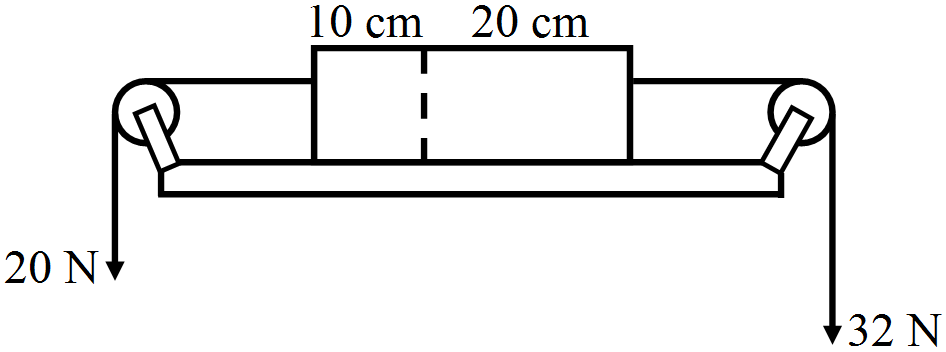
Figure shows a uniform rod of length $30cm$ having a mass of $3.0kg$. The strings shown in the figure are pulled by constant forces of $20N$ and $32N$. Find the force exerted by the $20cm$ part of the rod on the $10cm$ part. All the surfaces are smooth and the strings and the pulleys are light.
For a particle in S.H.M., the displacement x of the particle as a function of time t is given as $\text{x = A}\sin(2\pi\text{t}).$ Here x is in cm and t is in seconds.
Let the time taken by the particle to travel from x = 0 to $\text{x}=\frac{\text{A}}{2}$ be $T_1$ and the time taken to travel from $\text{x}=\frac{\text{A}}{2}$ to x = A be $T_2$​​​​​​​. Find $\frac{\text{T}_1}{\text{T}_2}.$
A $60kg$ man skating with a speed of $10m/s$ collides with a $40kg$ skater at rest and they cling to each other. Find the loss of kinetic energy during the collision.