Question
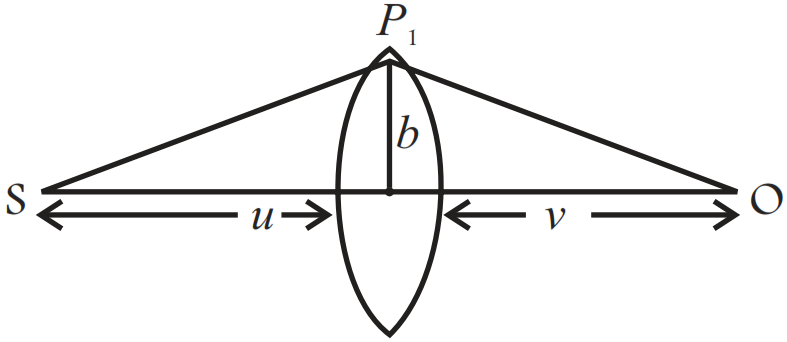
Consider a thin lens placed between a source (S) and an observer (O) (Fig). Let the thickness of the lens vary as $\text{w}\text{(b)}=\text{w}_0-\frac{\text{b}^2}{\alpha}$, where b is the verticle distance from the pole. w0 is a constant. Using Fermat’s principle i.e. the time of transit for a ray between the source and observer is an extremum, find the condition that all paraxial rays starting from the source will converge at a point O on the axis. Find the focal length.
Answer

The time taken by ray to travel from S to P1 is
$\text{t}_1=\frac{\text{SP}_1}{\text{c}}=\frac{\sqrt{\text{u}^2+\text{b}^2}}{\text{c}}$
or $\text{t}_1=\frac{\text{u}}{\text{c}}\Big(1+\frac{1}{2}\frac{\text{b}^2}{\text{u}^2}\Big)$ assuming b < < 1.
The time required to travel from P1 to O is
$\text{t}_2=\frac{\text{P}_1\text{O}}{\text{c}}=\frac{\sqrt{\text{v}^2+\text{b}^2}}{\text{c}}=\frac{\text{v}}{\text{c}}\Big(1+\frac{1}{2}\frac{\text{b}^2}{\text{v}^2}\Big)$
The time required to travel through the lens is
$\text{t}=\frac{(\text{n}-1)\text{w}(\text{b})}{\text{c}}$
where n is the refractive index.
Thus, the total time is
$\text{t}=\frac{1}{\text{c}}\bigg[\text{u}+\text{v}+\frac{1}{2}\text{b}^2\Big(\frac{1}{\text{u}}+\frac{1}{\text{v}}\Big)+(\text{n}-1)\text{w}(\text{b})\bigg]$
Put $\frac{1}{\text{D}}=\frac{1}{\text{u}}+\frac{1}{\text{v}}$
Then, $\text{t}=\frac{1}{\text{c}}\bigg[\text{u}+\text{v}+\frac{1}{2}\frac{\text{b}^2}{\text{D}}+(\text{n}-1)\Big(\text{w}_0+\frac{\text{b}^2}{\alpha}\Big)\bigg]$
Fermat's principle gives the time taken should be minimum.
For that first dericative should be zero.
$\frac{\text{dt}}{\text{db}}=0=\frac{\text{b}}{\text{CD}}-\frac{2(\text{n}-1)\text{b}}{\text{c}\alpha}$
Thus, a convergent lens is formed if $\alpha=2(\text{n}-1)\text{D}$. This is independent of and hence all paraxial rays from S will converge at O i.e., for rays b < < n and b < < v.
Since, $\frac{1}{\text{D}}=\frac{1}{\text{u}}+\frac{1}{\text{v}}$, the focal length is D.

Need a full question paper?

Generate a complete, print-ready paper with questions like this in minutes — across 16+ boards, with answer keys.

Start Generating Free

Similar questions

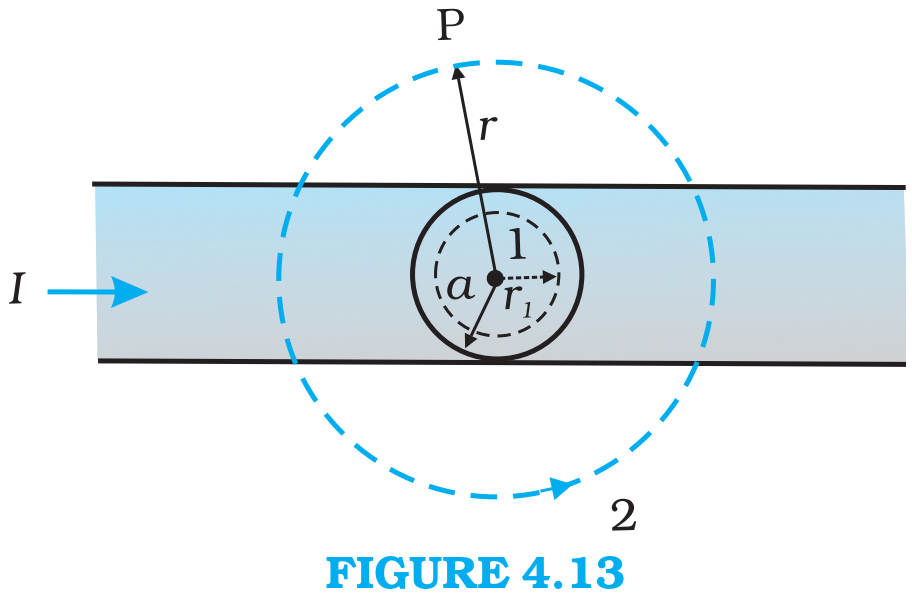
Figure 4.13 shows a long straight wire of a circular cross-section (radius a) carrying steady current $I$. The current $I$ is uniformly distributed across this cross-section. Calculate the magnetic field in the region $r<a$ and $r>a$.
Image
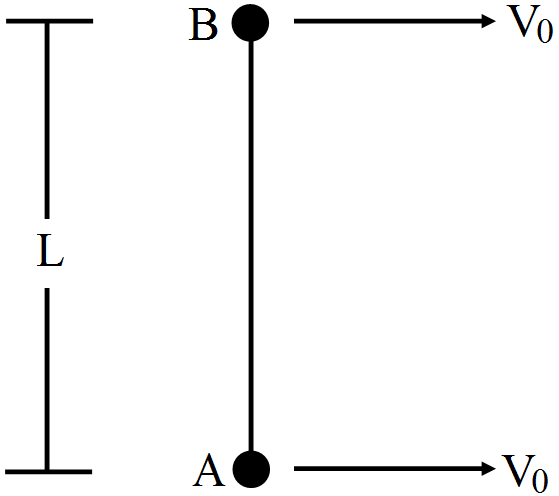
Two small balls A and B, each of mass m, are joined rigidly to the ends of a light rod of lengh L (figure). The system translates on a frictionless horizontal surface with a velocity vo in a direction perpendicular to the rod. A particle P of mass m kept at rest on the surface sticks to the ball A as the ball collides with it. Find:
  1. The linear speeds of the balls A and B after the collision.
  2. The velocity of the centre of mass C of the system A + B + P.
  3. The angular speed of the system about C after the collision.

[Hint: The light rod will exert a force on the ball B only along its length.]
Define the following and establish relation between them : (i) intensity of magnetisation (ii) magnetisation field (H) (iii) magnetic susceptibility $\chi$, (iv) magnetic permeability.###Explain permeability, susceptibility, intensity of magnetisation and magnetisation field $( H )_{ X }$ and state their units. Establish relation between them in M.K.S. system.
A gas is initially at a pressure of 100kPa and its volume is 2.0m3. Its pressure is kept constant and the volume is changed from 2.0m3 to 2.5m3. Its volume is now kept constant and the pressure is increased from 100kPa to 200kPa. The gas is brought back to its initial state, the pressure varying linearly with its volume.
  1. Whether the heat is supplied to or extracted from the gas in the complete cycle?
  2. How much heat was supplied or extracted?
Three immiscible liquids of densities d1 > d2 > d3 and refractive indices μ1 > μ2 > μ3 are put in a beaker. The height of each liquid column is $\frac{\text{h}}{3}$. A dot is made at the bottom of the beaker. For near normal vision, find the apparent depth of the dot.
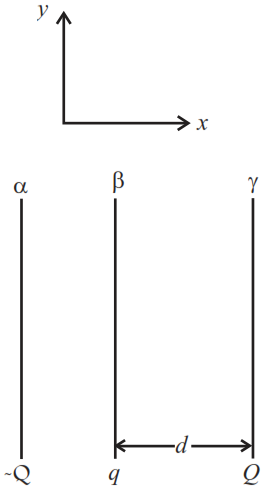
Two fixed, identical conducting plates $(\alpha\ \&\ \beta)$, each of surface area S are charged to -Q and q, respectively, where Q > q > 0. A third identical plate $(\gamma)$, free to move is located on the other side of the plate with charge q at a distance d (Fig.). The third plate is released and collides with the plate $\beta$. Assume the collision is elastic and the time of collision is sufficient to redistribute charge amongst $\beta\ \&\ \gamma$.

Find the charges on $\beta$ and $\gamma$ after the collision.
What is nature of electromagnetic waves? Explain propagation of wave with the help of a diagram and explain their characteristics in detail.
The $\text{K}_\alpha$ X-rays of aluminium (Z = 13) and zinc (Z = 30) have wavelengths 887pm and 146pm respectively. Use Moseley's law $\sqrt{\text{v}}=\text{a}(\text{z-b})$ to find the wavelengths of the $\text{K}_\alpha$ X-ray of iron (Z = 26).
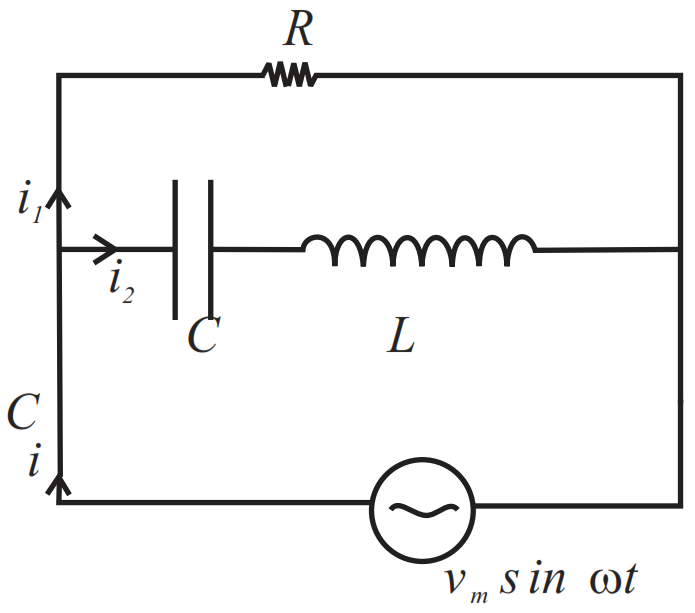
Consider the LCR circuit shown in Fig. Find the net current i and the phase of i. Show that . Find the impedence Z for this circuit.

(a) For circuits used for transporting electric power, a low power factor implies large power loss in transmission. Explain.
(b) Power factor can often be improved by the use of a capacitor of appropriate capacitance in the circuit. Explain.