MCQ
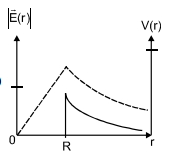
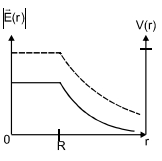
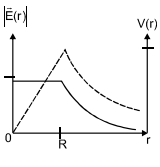
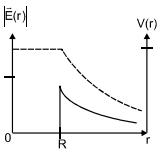
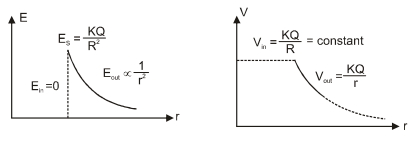
Consider a thin spherical shell of radius $R$ with its centre at the origin, carrying uniform positive surface charge density. The variation of the magnitude of the electric field $|\vec{E}(r)|$ and the electric potential $V(r)$ with the distance r from the centre, is best represented by which graph?
  • A

  • B

  • C


Answer

Correct option: D.

d

Need a full question paper?

Generate a complete, print-ready paper with questions like this in minutes — across 16+ boards, with answer keys.

Start Generating Free

Similar questions

While a capacitor remains connected to a battery and dielectric slab is applied between the plates, then
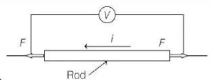
As shown in the schematic below, a rod of uniform cross-sectional area $A$ and length $l$ is carrying a constant current $i$ through it and voltage across the rod is measured using an ideal voltmeter. The rod is stretched by the application of a force $F$. Which of the following graphs would show the variation in the voltage across the rod as function of the strain $\varepsilon$ when the strain is small. Neglect Joule heating.
In a Young’s double slit experiment with slit separation $0.1\, mm$, one observes a bright fringe at angle $\frac{1}{{40}}\, rad$ by using light of wavelength ${\lambda _1}$. When the light of wavelength $\lambda _2$ is used a bright fringe is seen at the same angle in the same set up. Given that ${\lambda _1}$ and ${\lambda _2}$ are in visible range ($380\, nm$ to $740\, nm$), their values are
The internal resistance of a cell of e.m.f. 12V is $5\times 10^{-2}\Omega$ . It is connected across an unknown resistance. Voltage across the cell, when a current of 60 A is drawn from it, is
If nearly $10^5$ coulomb liberate 1 gm equivalent of aluminium, then the amount of aluminium (equivalent weight 9) deposited through electrolysis in 20 minutes by a current of 50 amp will be
The resistances of a wire at temperatures t℃ and 0℃ are related by
An achromatic convergent doublet of two lens in contact has a power of $+ 2\, D$. The convex lens is power $+ 5\, D$. What is the ratio of the dispersive powers of the convergent and divergent lenses?
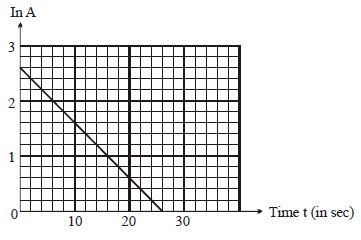
The graph in figure shows how the count-rate $A$ of a radioactive source as measured by a Geiger counter varies with time $t.$ The relationship between $A$ and $t$ is : $($ Assume $ln\,\, 12 = 2.6)$
If the luminous intensity of a 100 W unidirectional bulb is 100 candela, then total luminous flux emitted from the bulb is
The state of the energy gained by valance electrons when the temperature is raised or when electric field is applied is called as