Question
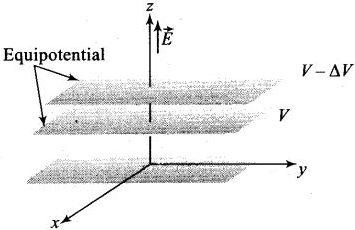
Consider a uniform electric field in the $\hat{\text{Z}}$ direction. The potential is a constant:

Answer

  1. For any x for a given z.
  2. For any y for a given z.
  3. On the x-y plane for a given z.
We know, the electric field intensity E and electric potential V are
$\text{E}=-\frac{\text{dV}}{\text{dr}}$

Electric potential decreases inf the direction of electric field. The direction of electric field is always perpendicular to one equipotential surface maintained at high electrostatic potential to other equipotential surface maintained at low electrostatic potential.
The electric field in z-direction suggest that equipotential surfaces are in x-y plane. Therefore the potential is a constant for any x for a given z, for any y for a given z and on the x-y plane for a given z.

Need a full question paper?

Generate a complete, print-ready paper with questions like this in minutes — across 16+ boards, with answer keys.
Start Generating Free

Similar questions

A semi$-$circular arc of radius $'a\ '$ is charged uniformly and the charge per unit lengths is $\lambda$. The electric field at the centre is:
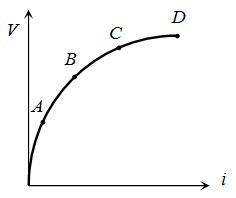
Variation of current passing through a conductor as the voltage applied across its ends as varied is shown in the adjoining diagram. If the resistance $(R)$ is determined at the points $A, B, C$ and $D,$ we will find that
Pick out the longest wavelength from the following types of radiations(a) Blue light(b) g-rays(c) X-rays  (d) Red light
       
Electrical conductivity of a semiconductor(a) Decreases with the rise in its temperature (b) Increases with the rise in its temperature (c) Does not change with the rise in its temperature(d) First increases and then decreases with the rise in its temperature


The Bohr model for the spectra of a $H-$atom$:$
The binding energy per nucleon of iron atom is approximately.
Magnetic field intensity at the centre of coil of $50$ turns, radius $0.5 m$ and carrying a current of $2 A$ is
There are two conductors X and Y carrying a current I and moving in the same direction. p and q are two electron beams also moving in the same direction. Will there be attraction or repulsion between the 2 conductors and between the two electron beams separately?
Take the effect of bulging of earth and its rotation in account. Consider the following statements:
  1. There are points outside the earth where the value of g is equal to its value at the equator.
  2. There are points outside the earth where the value of g is equal to its value at the poles.
  1. Both A and B are correct.
  2. A is correct but B is wrong.
  3. B is correct but A is wrong.
  4. Both A and B are wrong.
As the temperature of a metallic resistor is increased, the product of its resistivity and conductivity: