MCQ
Consider a uniform electric field in the $\hat{\text{Z}}$ direction. The potential is a constant:
- AIn all space.
- BFor any x for a given z.
- CFor any y for a given z.
- DOn the x-y plane for a given z.
We know, the electric field intensity E and electric potential V are
$\text{E}=-\frac{\text{dV}}{\text{dr}}$
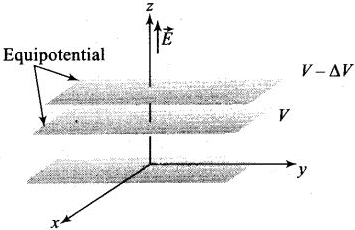
Electric potential decreases inf the direction of electric field. The direction of electric field is always perpendicular to one equipotential surface maintained at high electrostatic potential to other equipotential surface maintained at low electrostatic potential.
The electric field in z-direction suggest that equipotential surfaces are in x-y plane. Therefore the potential is a constant for any x for a given z, for any y for a given z and on the x-y plane for a given z.
Generate a complete, print-ready paper with questions like this in minutes — across 16+ boards, with answer keys.
$\frac{\text{l}_1+\text{l}_2}{2}$
$\sqrt{\text{l}_2\text{l}_2}$
$\frac{\text{l}_1\text{T}_2-\text{l}_2\text{T}_1}{\text{T}_2-\text{T}_1}$
$\frac{\text{l}_1\text{T}_2+\text{l}_2\text{T}_1}{\text{T}_2+\text{T}_1}$
An electron in the n = 1 orbit of hydrogen atom is bound by 13.6 eV energy is required to ionize it is
|
(a) 13.6 eV |
(b) 6.53 eV |
(c) 5.4 eV |
(d) 1.51 eV |
The mass of a substance liberated when a charge ‘q’ flows through an electrolyte is proportional to
|
(a) q |
(b) 1/q |
(c) |
(d) 1/ |
Which of the following waves have the maximum wavelength
|
(a) X-rays |
(b) I.R. rays |
(c) UV rays |
(d) Radio waves |
