Question
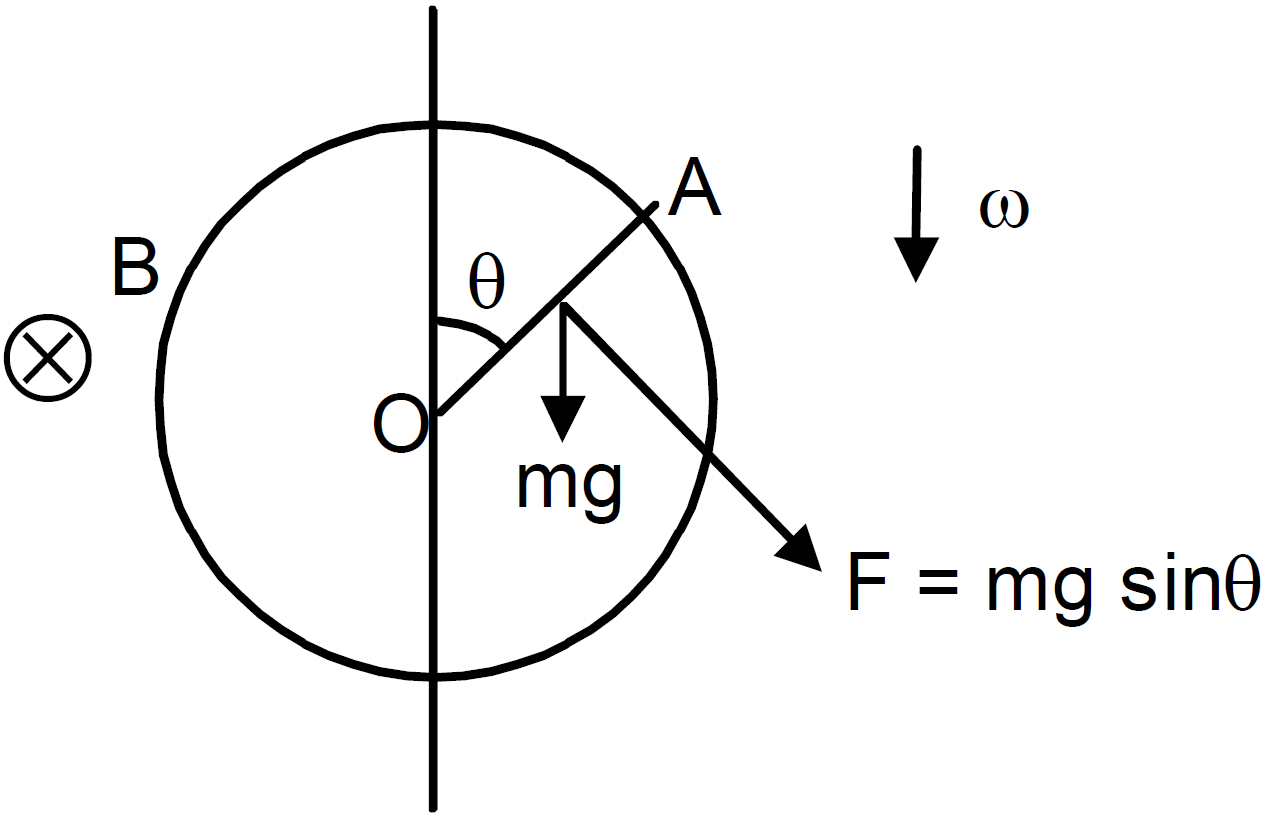
Consider a variation of the previous problem (figure). Suppose the circular loop lies in a vertical plane. The rod has a mass m. The rod and the loop have negligible resistances but the wire connecting O and C has a resistance R. The rod is made to rotate with a uniform angular velocity $\omega$ in the clockwise direction by applying a force at the midpoint of OA in a direction perpendicular to it. Find the magnitude of this force when the rod makes an angle $\theta$ with the vertical.
Answer


We know
$\text{F}=\frac{\text{B}^2\text{a}^3\omega}{2\text{R}}=\text{il}\text{B}$
Component of mg along $\text{F}=\text{mg } \sin \theta$
Net force $=\frac{\text{B}^2\text{a}^3\omega}{2\text{R}}-\text{mg }\sin\theta$

Need a full question paper?

Generate a complete, print-ready paper with questions like this in minutes — across 16+ boards, with answer keys.

Start Generating Free

Similar questions

A rod of mass m and length L, lying horizontally, is free to rotate about a vertical axis through its centre. A horizontal force of constant magnitude F acts on the rod at a distance of $\frac{\text{L}}{4}$ from the centre. The force is always perpendicular to the rod. Find the angle rotated by the rod during the time (t) after the motion starts.
A parallel-plate capacitor of plate-area A and plate separation d is joined to a battery of emf $\in$ and internal resistance R at t = 0. Consider a plane surface of area $\frac{\text{A}}{2}$ parallel to the plates and situated symmetrically between them. Find the displacement current through this surface as a function of time.
A particle is subjected to two simple harmonic motions, one along the X-axis and the other on a line making an angle of 45° with the X-axis, The two motions are given by,$\text{x}=\text{x}_0\sin\omega\text{t}$ and $\text{s}=\text{s}_0\sin\omega\text{t}$
Find the amplitude of the resultant motion.
A monkey of mass $15kg$ is climbing on a rope with one end fixed to the ceiling. If it wishes to go up with an acceleration of $1m/s^2$, how much force should it apply to the rope? If the rope is $5m$ long and the monkey starts from rest, how much time will it take to reach the ceiling?
A flywheel of moment of inertia $5.0\ kg-m^2$ is rotated at a speed of $60\ \text{rad/s.}$ Because of the friction at the axle, it comes to rest in $5.0$ minutes. Find:
  1. The average torque of the friction.
  2. The total work done by the friction.
  3. The angular momentum of the wheel $1$ minute before it stops rotating.
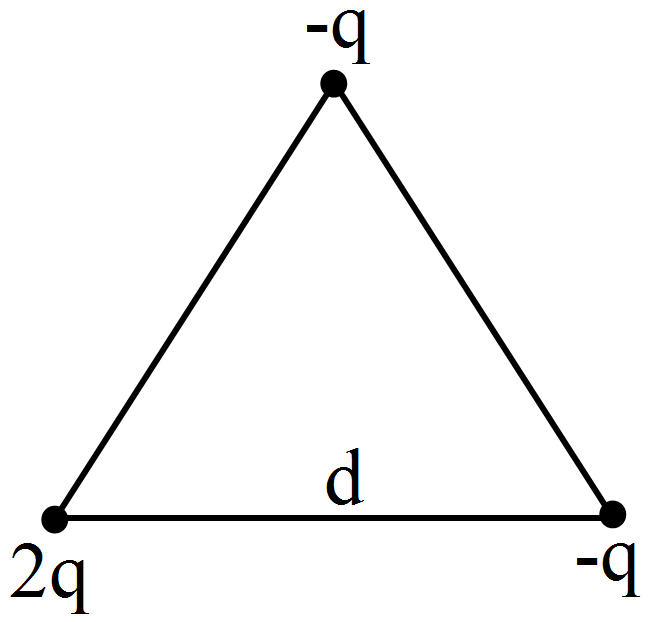
Three charges are arranged on the vertices of an equilateral triangle as shown in figure. Find the dipole moment of the combination.
Explain why: An optical pyrometer (for measuring high temperatures) calibrated for an ideal black body radiation gives too low a value for the temperature of a red hot iron piece in the open, but gives a correct value for the temperature when the same piece is in the furnace.
A ball moving with a momentum of $15kg ms^{-1}$ strikes against the wall at an angle of $30°$ and is reflected with the same momentum at the same angle. Calculate impulse.
The driver of a truck travelling with a velocity v suddenly notices a brick wall in front of him at a distance d. Is it better for him to apply brakes or to make a circular turn without applying brakes in order to just avoid crashing into the wall? Why?
Define the term 'coefficient of limiting friction' between two surfaces. A body of mass 10kg is placed on an inclined surface of angle 30°. If the coefficient of limiting friction is $\frac{1}{\sqrt{3}}$ find the force required to just push the body up the inclined surface. The force is being applied parallel to the inclined surface.