MCQ
Consider a vector $\overrightarrow F = 4\hat i - 3\hat j.$ Another vector that is perpendicular to $\overrightarrow F $ is
  • A
    $4\hat i + 3\hat j$
  • B
    $6\hat i$
  • $7\hat k$
  • D
    $3\hat i - 4\hat j$

Answer

Correct option: C.
$7\hat k$
c
(c) Force $F$ lie in the $x-y$ plane so a vector along $Z-$axis will be perpendicular to $F$.

Need a full question paper?

Generate a complete, print-ready paper with questions like this in minutes — across 16+ boards, with answer keys.
Start Generating Free

Similar questions

If two vectors $2\hat i + 3\hat j - \hat k$ and $ - 4\hat i - 6\hat j + \lambda \hat k$ are parallel to each other then value of $\lambda$ be
The fundamental frequency of a sonometre wire is $n.$ If its radius is doubled and its tension becomes half, the material of the wire remains same, the new fundamental frequency will be
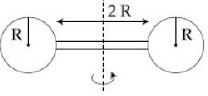
Two identical spherical balls of mass $M$ and radius $R$ each are stuck on two ends of a rod of length $2R$ and mass $M$ (see figure). The moment of inertia of the system about the axis passing perpendicularly through the centre of the rod is
The energy stored in wound watch spring is
At what height above the surface of earth the value of $"g"$ decreases by $2 \%$ ..... $km$ [radius of the earth is $6400 \,km$ ]
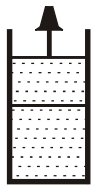
In the figure a container is shown to have a movable (without friction) piston on top. The container and the piston are all made of perfectly insulating material allowing no heat transfer between outside and inside the container. The container is divided into two compartments by a rigid partition made of a thermally conducting material that allows slow transfer of heat. The lower compartment of the container is filled with $2$ moles of an ideal monatomic gas at $700 \ K$ and the upper compartment is filled with $2$ moles of an ideal diatomic gas at $400$

K. The heat capacities per mole of an ideal monatomic gas are $C_v=\frac{3}{2} \ R, C_p=\frac{5}{2} R$, and those for an ideal diatomic gas are $C _{ v }=\frac{5}{2} \ R , C _{ P }=\frac{7}{2} R$.

$1.$ Consider the partition to be rigidly fixed so that it does not move. When equilibrium is achieved, the final temperature of the gases will be :

$(A)$ $550 \ K$ $(B)$ $525 \ K$ $(C)$ $513 \ K$ $(D)$ $490 \ K$

$2.$ Now consider the partition to be free to move without friction so that the pressure of gases in both compartments is the same. Then total work done by the gases till the time they achieve equilibrium will be:

$(A)$ $250 \ R$ $(B)$ $200 \ R$ $(C)$ $100 \ R$ $(D)$ $-100 \ R$

Give the answer question $1$ and $2.$
A source emits a sound of frequency of $400 Hz$, but the listener hears it to be $390 Hz.$ Then
A certain amount of gas is taken through a cyclic process $(A\,B\,C\,D\,A)$  that has two isobars, one isochore and one isothermal. The cycle can be represented on a $P-V$ indicator diagram as
If the temperature of a black body be increased from ${27^o}C$ to ${327^o}C$ the radiation emitted increases by a fraction of
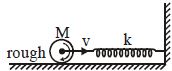
A solid sphere rolls without slipping and presses a spring of spring constant $k$ as shown in figure. Then, the maximum compression in the spring will be