MCQ
Consider a wire carrying a steady current, I placed in a uniform magnetic field B perpendicular to its length. Consider the charges inside the wire. It is known that magnetic forces do no work. This implies that:
  • A
    Motion of charges inside the conductor is unaffected by B since they do not absorb energy.
  • B
    Some charges inside the wire move to the surface as a result of B.
  • C
    If the wire moves under the influence of B, no work is done by the force.
  • D
    If the wire moves under the influence of B, no work is done by the magnetic force on the ions, assumed fixed within the wire.
Answer

  1. Some charges inside the wire move to the surface as a result of B.​​​​​​
  1. If the wire moves under the influence of B, no work is done by the magnetic force on the ions, assumed fixed within the wire.

Solution:

Magnetic force on a conductor of length l carrying a current I placed in a uniform magnetic field B is given by, $\text{F}=\text{I}(\text{l}\times\text{B})\text{ or }|\text{F}|=\text{I }|\text{l}| \ \ |\text{B}|\sin\theta$.

The direction of force is given by Fleming's left hand rule & F is perpendicular to the direction of magnetic field B, Therefore, work done by the magnetic force on the ions is zero.

Need a full question paper?

Generate a complete, print-ready paper with questions like this in minutes — across 16+ boards, with answer keys.

Start Generating Free

Similar questions

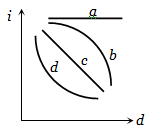
A point source of light is used in an experiment on photoelectric effect. Which of the following curves best represents the variation of photo current (i) with distance (d) of the source from the emitter

(a) a 

(b) b

(c) c  

(d) d

The e.m.f. in a thermoelectric circuit with one junction at and the other at t is given by . The neutral temperature is then

(a)         

(b) -  

(c) -  

(d)  

Which of the following materials is non crystalline

(a) Copper

(b) Sodium chloride

(c) Wood 

(d) Diamond

Which of the following graphs shows the variation of magnetic induction B with distance r from a long wire carrying current

(a)

(b)

(c)

(d)

The ionisation potential of hydrogen atom is 13.6 volt. The energy required to remove an electron in the n = 2 state of the hydrogen atom is

(a) 27.2 eV

(b) 13.6 eV

(c) 6.8 eV                                          

(d) 3.4 eV

Which of the following quantities are always negative in a simple harmonic motion?

  1. $\overrightarrow{\text{F}}.\overrightarrow{\text{a}}$

  2. $\overrightarrow{\text{v}}.\overrightarrow{\text{r}}$

  3. $\overrightarrow{\text{a}}.\overrightarrow{\text{r}}$

  4. $\overrightarrow{\text{F}}.\overrightarrow{\text{r}}$

Current of 1 A is flowing through two parallel wires in the same direction and distance between the wires is 1 m . The mutual attractive force at unit length will be :
A particle is acted upon by a force of constant magnitude which is always perpendicular to the velocity of the particle. The motion of the particle takes place in a plane. It follows that:
  1. Its velocity is constant.
  2. Its acceleration is constant.
  3. Its kinetic energy is constant.
  4. It moves in a circular path.
What will be the nature of charge on the metal paper clip of electroscope when a negatively charged body is brought in contact with it?
A ferromagnetic material is placed in an external magnetic field. The magnetic domains:
  1. Increase in size.
  2. Decrease in size.
  3. May increase or decrease in size.
  4. Have no relation with the field.