Question
  1. Consider an arbitrary electrostatic field configuration. A small test charge is placed at a null point (i.e., where E = 0) of the configuration. Show that the equilibrium of the test charge is necessarily unstable.
  2. Verify this result for the simple configuration of two charges of the same magnitude and sign placed a certain distance apart.
Answer

  1. Let the equilibrium of the test charge be stable. If a test charge is in equilibrium and displaced from its position in any direction, then it experiences a restorinq force towards a null point, where the electric field is zero. All the field lines near the null point are directed inwards towards the null point. There is a net inward flux of electric field through a closed surface around the null point. According to Gauss's law, the flux of electric field through a surface, which is not enclosing any charge, is zero. Hence, the equilibrium of the test charge can be stable.
  2. Two charges of same magnitude and same sign are placed at a certain distance. The mid-point of the joining line of the charges is the null point. When a test charged is displaced along the line, it experiences a restoring force. If it is displaced normal to the joining line, then the net force takes it away from the null point. Hence, the charge is unstable because stability of equilibrium requires restoring force in all directions.

Need a full question paper?

Generate a complete, print-ready paper with questions like this in minutes — across 16+ boards, with answer keys.

Start Generating Free

Similar questions

Can an electromagnetic wave be polarised?
An inductor-coil, a capacitor and an AC source of rms voltage 24V are connected in series. When the frequency of the source is varied, a maximum rms current of 6.0A is observed. If this inductor coil is connected to a battery of emf 12V and internal resistance $4.0\Omega,$ what will be the current?
  1. Define torque acting on a dipole of dipole moment $\overrightarrow{p}$ placed in a uniform electric field $\overrightarrow{\text{E}}$. Express it in the vector form and point out the direction along which it acts.
  2. What happens if the field is non-uniform?
  3. What would happen if the external field $\overrightarrow{\text{E}}$ is increasing (i) parallel to $\overrightarrow{p}$ and (ii) anti-parallel to $\overrightarrow{p}$?
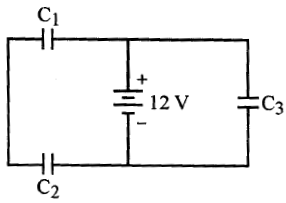
Three identical capacitors C1, C2 and C3 of capacitance 6 µF each are connected to a 12 V battery as shown.

Find:

  1. charge on each capacitor.
  2. equivalent capacitance of the network.
  3. energy stored in the network of capacitors.
A proton and an α-particle move perpendicular to a magnetic field. Find the ratio of radii of the circular paths described by them when both (i) have equal momenta, and (ii) were accelerated through the same potential difference.
A thin conducting spherical shell of radius R has charge Q spread uniformly over its surface. Using Gauss’s law, derive an expression for an electric field at a point outside the shell.

Draw a graph of electric field E(r) with distance r from the centre of the shell for $0\underline{<}\text{r}\underline{<}\infty.$

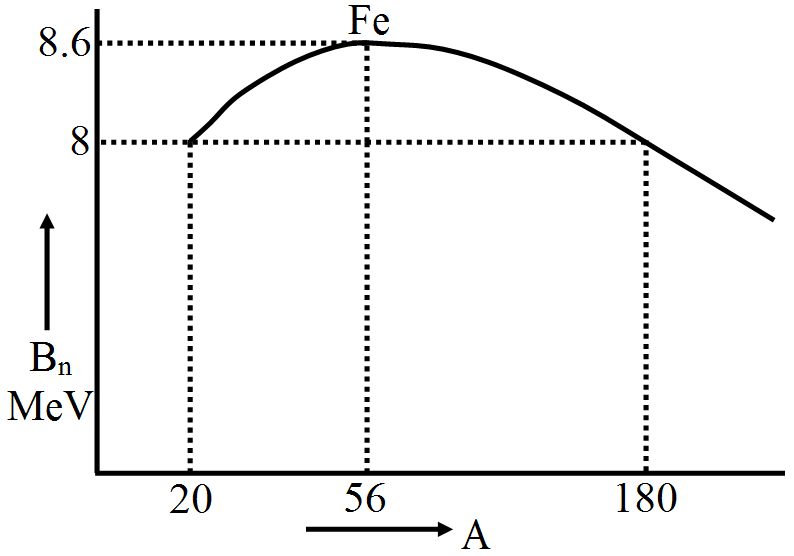
Draw the graph showing the variation of binding energy per nucleon with mass numbers. Give the reason for the decrease of binding energy per nucleon for nuclei with higher mass number.

A simple pendulum consists of a 50cm long string connected to a 100g ball. The ball is pulled aside so that the string makes an angle of 37° with the vertical and is then released. Find the tension in the string when the bob is at its lowest position.

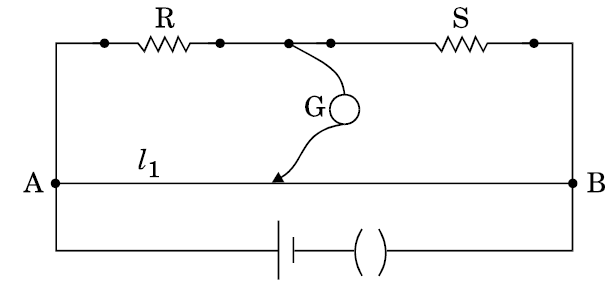
  1. Write the principle of working of a metre bridge.
  2. In a metre bridge, the balance point is found at a distance $l_1$ with resistances R and S as shown in the figure.

An unknown resistance X is now connected in parallel to the resistance S and the balance point is found at a distance $l_2$. Obtain a formula for X in terms of $l_1$, $l_2$ and S.