MCQ

Consider an extended object immersed in water contained in a plane trough. When seen from close to the edge of the trough the object looks distorted because:

  • A
    The apparent depth of the points close to the edge are nearer the surface of the water compared to the points away from the edge.
  • B
    The angle subtended by the image of the object at the eye is smaller than the actual angle subtended by the object in air.
  • C
    Some of the points of the object far away from the edge may not be visible because of total internal reflection.
  • D
    Water in a trough acts as a lens and magnifies the object.
Answer

  1. The apparent depth of the points close to the edge are nearer the surface of the water compared to the points away from the edge.
  2. The angle subtended by the image of the object at the eye is smaller than the actual angle subtended by the object in air.
  3. Some of the points of the object far away from the edge may not be visible because of total internal reflection.

Solution:

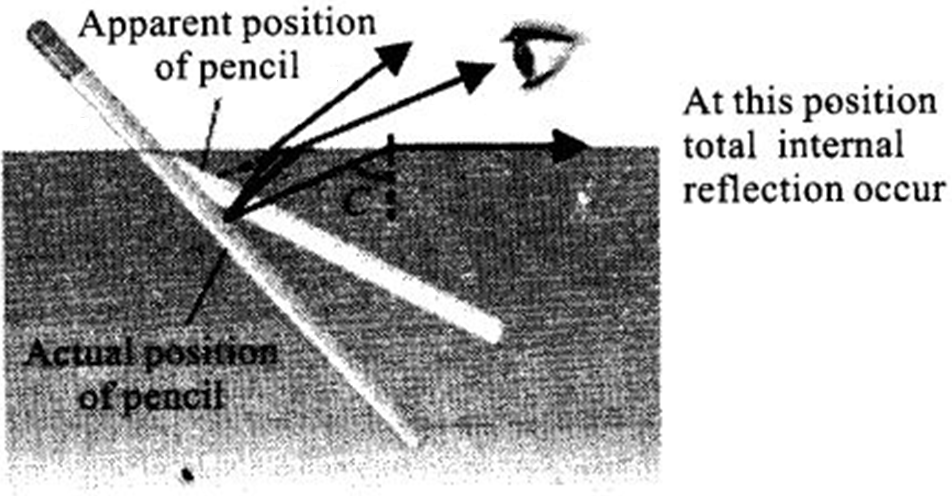
Key concept: The light from the pencil is refracted when it passes from the water into air, bending away from the normal as it moves from high to low refractive index.

When light from the submerged object before reaching to the observer gets, refracted from water surface, the rays bend away from normal and the angle subtended by the image of the object at the eye is smaller than the actual angle subtended by the object in air. Also the apparent depth of the .points close to the edge are nearer the surface of the water compared to the points away from the edge.

As we move towards right, the angle of incident increases and becomes equal to critical angle. Hence some of the points of the object far away from the edge may not be visible because of total internal reflection.

Need a full question paper?

Generate a complete, print-ready paper with questions like this in minutes — across 16+ boards, with answer keys.

Start Generating Free

Similar questions

If we double the radius of a coil keeping the current through it unchanged, then the magnetic field at any point at a large distance from the centre becomes approximately:
In the Davisson and Germer experiment, the velocity of electrons emitted from the electron gun can be increased by?

Magnetic field intensity at the centre of coil of 50 turns, radius 0.5 m and carrying a current of 2 A is

(a) 0.5  

(b) 1.25  

(c) 3  

(d) 4  

A magnetic field

(a) Always exerts a force on a charged particle

(b) Never exerts a force on a charged particle

(c) Exerts a force, if the charged particle is moving across the magnetic field lines

(d) Exerts a force, if the charged particle is moving along the magnetic field lines

The electric potential V is given as a function of distance x (metre) by )volt. Value of electric field at x = 1  is

(a) 20 V/m

(b) 6 V/m

(c) 11 V/m

(d) -23 V/m

 Find equivalent capacitance between A and B

A point object is placed at a distance of 30 cm from a convex mirror of focal length 30cm. The image will form at

(a) Infinity

(b) Focus

(c) Pole

(d) 15 cm behind the mirror

Sinusoidal carrier voltage of frequency 1.5 MHz and amplitude 50 V is amplitude modulated by sinusoidal voltage of frequency 10 kHz producing 50% modulation. The lower and upper side-band frequencies in kHz are

(a) 1490, 1510

(b) 1510, 1490

(c)  

(d)  

A 10 metre wire kept in east-west falling with velocity 5 m/sec perpendicular to the field 0.3 .  The induced e.m.f. across the terminal will be

(a)  0.15 V

(b) 1.5 mV

(c)  1.5 V 

(d) 15.0 V

If   is 6563 Å, then wave length of second line for Balmer series will be

(a)  

(b)  

(c)  

(d) None of the above