MCQ

Consider an extended object immersed in water contained in a plane trough. When seen from close to the edge of the trough the object looks distorted because:

  • A
    The apparent depth of the points close to the edge are nearer the surface of the water compared to the points away from the edge.
  • B
    The angle subtended by the image of the object at the eye is smaller than the actual angle subtended by the object in air.
  • C
    Some of the points of the object far away from the edge may not be visible because of total internal reflection.
  • D
    Water in a trough acts as a lens and magnifies the object.
Answer

  1. The apparent depth of the points close to the edge are nearer the surface of the water compared to the points away from the edge.
  2. The angle subtended by the image of the object at the eye is smaller than the actual angle subtended by the object in air.
  3. Some of the points of the object far away from the edge may not be visible because of total internal reflection.

Solution:

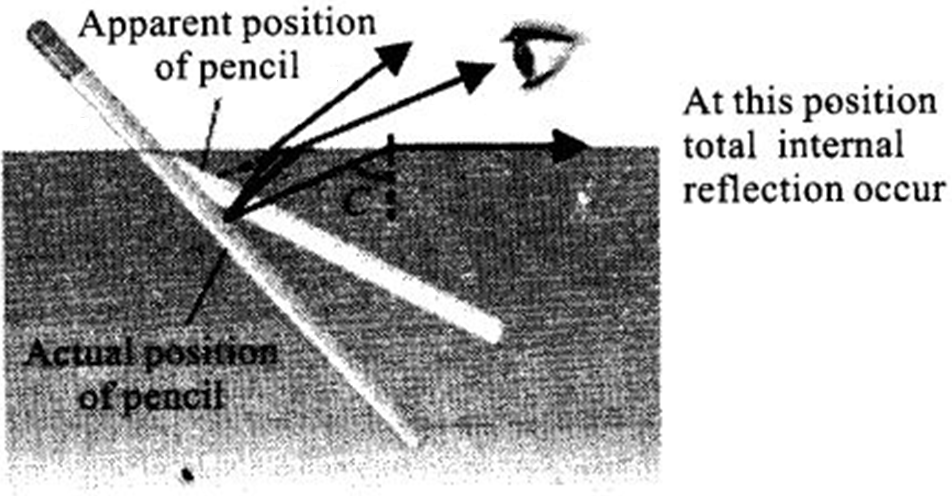
Key concept: The light from the pencil is refracted when it passes from the water into air, bending away from the normal as it moves from high to low refractive index.

When light from the submerged object before reaching to the observer gets, refracted from water surface, the rays bend away from normal and the angle subtended by the image of the object at the eye is smaller than the actual angle subtended by the object in air. Also the apparent depth of the .points close to the edge are nearer the surface of the water compared to the points away from the edge.

As we move towards right, the angle of incident increases and becomes equal to critical angle. Hence some of the points of the object far away from the edge may not be visible because of total internal reflection.

Need a full question paper?

Generate a complete, print-ready paper with questions like this in minutes — across 16+ boards, with answer keys.

Start Generating Free

Similar questions

Which is the wrong statement in following sentences? A device in which P and N-type semiconductors are used is more useful then a vacuum type because

(a) Power is not necessary to heat the filament

(b) It is more stable


(c) Very less heat is produced in it

(d) Its efficiency is high due to a high voltage across the junction

An interference pattern was made by using red light. If the red light changes with blue light, the fringes will become

(a) Wider  

(b) Narrower

(c) Fainter

(d) Brighter

Full wave rectifier uses:
A coil of copper and a wire AB are located in the plane of the paper as shown in the figure. If current I flowing through the wire is increasing, then the direction of induced current in the coil is:
Image
Electric current produced by a moving straight wire in a magnetic field is?

The probability of electrons to be found in the conduction band of an intrinsic semiconductor at a finite temperature

(a) Decreases exponentially with increasing band gap

(b) Increases exponentially with increasing band gap

(c) Decreases with increasing temperature

(d) Is independent of the temperature and the band gap

If  be the electric field strength of a short dipole at a point on its axial line and  that on the equatorial line at the same distance, then

(a)  

(b)  

(c)  

(d) None of the above

Electric field lines of force:

A long wire carries a steady current. It is bent into a circle of one turn and the magnetic field at the centre of the coil is B. It is then bent into a circular loop of n turns. The magnetic field at the centre of the coil will be

(a) nB

(b) n2B

(c) 2nB

(d) 2n2B

Light of two different frequencies whose photons have energies 1eV and 2.5eV respectively, successively illuminates a metal of work function 0.5eV. The ratio of maximum kinetic energy of the emitted electron will be

(a) 1 : 5

(b) 1 : 4

(c) 1 : 2

(d) 1 : 1