MCQ
Consider following forces: (w) Force due to tension along a string, (x) Normal force given by a surface, (y) Force due to air resistance and (z) Buoyant force or upthrust given by a fluid.
Which of these are electromagnetic forces?
  • A
    Only w, y and z
  • B
    Only w, x and y
  • C
    Only x, y and z
  • All four.

Answer

Correct option: D.
All four.
All four.

Need a full question paper?

Generate a complete, print-ready paper with questions like this in minutes — across 16+ boards, with answer keys.

Start Generating Free

Similar questions

A man weighing 60 kg is in a lift moving down with an acceleration of $1.8 ms^{-2}$ The force exerted by the floor on him is
A particle is moving with a uniform speed in a circular orbit of radius R in a central force inversely proportional to the $n ^{\text {th }}$ power of R. If the period of rotation of the particle is T, then:
A body travelling along a straight line path travels first half of the distance with a velocity $7 ms^{-1}.$ During the travel time of the second half of the distance, first half time is travelled with a velocity $14 ms^{-1}$ and the second half time is travelled with a velocity $21 ms^{-1}.$ Then the average of the body during the journey is
A time dependent force F = 6t acts on a particle of mass 1 kg. If the particle starts from rest, the work done by the force during the first 1 sec. will be
A 2 kg body and a 3 kg body are moving along the x-axis. At a particular instant the 2 kg body has a velocity of $3 ms^{-1}$ and the 3 kg body has the velocity of 2 ms -1. the velocity of the centre of mass of that instant is
Wavelength of the transverse wave is 30 cm. If the particle at some instant has displacement 2 cm, find the displacement of the particle 15 cm away at the same instant.
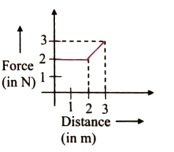
A particle moves in one dimension from rest under the influence of a force that varies with the distance travelled by the particle as shown in the figure. The kinetic energy of the particle after it has travelled 3 m is:
Image
Preeti reached the metro station and found that the escalator was not working. She walked up the stationary escalator in time $t_1.$ On other days, if she remains stationary on the moving escalator, then the escalator takes her up in time $t_2.$ The time taken by her to walk up on the moving escalator will be:
The SI unit of the emf of a cell is
Let ' $g_h$ ' and ' $g_d$ ' be the accelerations due to gravity at height ' $h$ ' above the earth's surface and at depth ' $d$ ' below the earth's surface respectively. If $g_h=g_d$ then the relation between ' $h$ ' and ' $d$ ' is