Question
Consider the available processes given below in the ready queue for execution and with given burst
time.
Process NoArrival TimeBurst time
P102
P212
P353
P464
a) What is the time at which all the processes get executed?
b) Find the average waiting time and average turnaround time using thenon - pre-emptive FCFS
scheduling algorithm.

Answer


Image
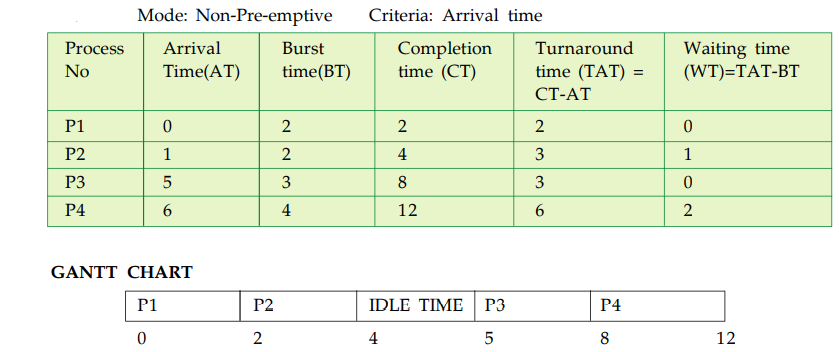
Arrival time of P1 is 0 and it gets executed for 2 units of time. While P1 is being executed P2
has already arrived in ready queue after 1 unit of time. Completion time for P2 is 4 units. Since P3
arrives after 5 units of time, the processor remains idle for 1 unit of time. When time is 5 units P3
arrives and get executed for 3 units of time. After 6 units of time P4 is in ready queue. Thus, its
completion time is 12 units.
a) All the processes got executed at 12 units of time
b) Average waiting time $=\frac{0+1+0+2}{4}=0.75$ units
Average turnaround time $=\frac{2+3+3+6}{4}=3.5$ units

Need a full question paper?

Generate a complete, print-ready paper with questions like this in minutes — across 16+ boards, with answer keys.

Start Generating Free

Similar questions

Prove that the following inequality holds true:
$
\sqrt{5}+\sqrt{3}>\sqrt{6}+\sqrt{2}
$
Find the adjoint of the matrix $A=\left[\begin{array}{rrr}-1 & -2 & -2 \\ 2 & 1 & -2 \\ 2 & -2 & 1\end{array}\right]$ and hence show that $A(\operatorname{adj} A)=|A| I_{3}$.
In the proportion of defective in a bulk is 4%. Find the probability of not more than 2 defective in a sample of 10. It is known that $e^{-4}=0.6703.$
Calculate four-Yearly moving averages of number of students studying in a higher secondary school in a particular city from the following data.
YearNumber of Students
2011124
2012120
2013135
2014140
2015145
2016158
2017162
2018170
2019175
In a 1000-metre race, A, B and C get Gold, Silver and Bronze medals respectively. If A beats B by 100 metres and B beats C by 100 metres, then by how many metres does A beat C?
Express the matrix $A =\left[\begin{array}{rrr}4 & 2 & -1 \\ 3 & 5 & 7 \\ 1 & -2 & 1\end{array}\right]$ as the sum of a symmetric and a skew-symmetric matrix.
Given $A=\left[\begin{array}{lll}5 & 0 & 4 \\ 2 & 3 & 2 \\ 1 & 2 & 1\end{array}\right], B^{-1}=\left[\begin{array}{lll}1 & 3 & 3 \\ 1 & 4 & 3 \\ 1 & 3 & 4\end{array}\right],$ compute $(A B)^{-1}.$
Two cards are drawn successively with replacement from a well-shuffled deck of 52 cards. Compute the
variance of the number of aces.
A farm is engaged in breeding pigs. The pigs are fed on various products grown on the farm. In view of the need to ensure certain nutrient constituents (call them X, Y and Z), it is necessary to buy two additional products, say, A and B. One unit of product A contains 36 units of X, 3 units of Y, and 20 units of Z. One unit of product B contains 6 units of X, 12 units of Y and 10 units of Z. The minimum requirement of X, Y and Z is 108 units, 36 units and 100 units respectively. Product A costs ₹ 20 per unit and product B costs ₹ 40 per unit. Formulate the above as a linear programming problem to minimize the total cost, and solve the problem by using graphical method.