MCQ
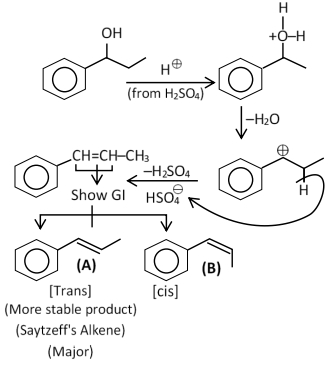
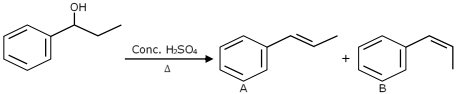
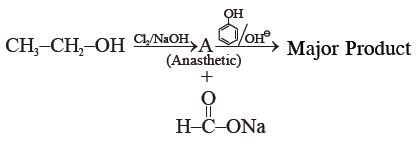
Consider the below reaction, and choose the correct statement:
  • A
    The reaction is not possible in acidic medium
  • B
    Both compounds $A$ and $B$ are formed equally
  • C
    Compound $B$ will be the major product
  • Compound $A$ will be the major product

Answer

Correct option: D.
Compound $A$ will be the major product
d

Need a full question paper?

Generate a complete, print-ready paper with questions like this in minutes — across 16+ boards, with answer keys.
Start Generating Free

Similar questions

In a $0.2\,\,molal$  aqueous solution of a weak acid $HX$  the degree of ionisation is $0.25.$  The freezing point of the solution will be nearest to ......... $^oC$. $(K_f = 1.86\,K \,\,kg\,mol^{-1})$
Xenon hexafluoride on partial hydrolysis produces compounds $'X'$ and $'Y'$ . Compounds $'X'$ and $'Y'$ and the oxidation state of $Xe$ are respectively
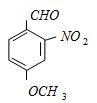
What is the correct $IUPAC$ name of
Which element is alloyed with copper to form bronze
Suppose the following reaction -

The structure of Major Product will be
A compound ($60 \,g$) on analysis gave $C = 24\, g$, $H = 4 \,g$, $O = 32\, g$. Its empirical formula is
To neutralise $20\, ml $ of $M/10$ sodium hydroxide, the volume of $M/20$ hydrochloric acid required is .............. $\mathrm{ml}$
The correct $IUPAC$ name for the compound $[CO(NH_3)_4Cl(ONO]Cl$ is
Given, $pH$ of a solution $A$ is $3$ and it is mixed with another solution $B$ having $pH\,2$. If both are mixed in equal volume, then the resultant $pH$ of the solution will be
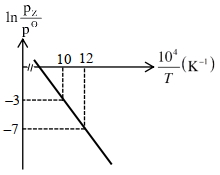
For the reaction $X ( s ) \rightleftharpoons Y ( s )+ Z ( g )$, the plot of $\ln \frac{ p _z}{ p ^\theta}$ versus $\frac{10^4}{T}$ is given below (in solid line), where $p_z$ is the pressure (in bar) of the gas $Z$ at temperature $T$ and $P ^{\ominus}=1$ bar.

(Given, $\frac{ d (\ln K )}{ d \left(\frac{1}{T}\right)}=-\frac{\Delta H^{\ominus}}{ R }$, where the equilibrium constant, $K =\frac{ p _{ z }}{ p ^{\ominus}}$ and the gas constant, $R =8.314$ $\left.J K ^{-1} mol ^{-1}\right)$

($1$) The value of standard enthalpy, $\Delta H ^{\ominus}$ (in $kJ mol ^{-1}$ ) for the reaction is. . . . . . .

($2$) The value of $\Delta S^{\ominus}$ (in $J K ^{-1} mol ^{-1}$ ) for the given reaction, at $1000 K$ is. . . . . . 

Give the answer or quetin ($1$) and ($2$)