- ✓$6,\,3,\,6,\,0$
- B$7,\,2,\,7,\,1$
- C$7,\,1,\,6,\,4$
- D$6,\,2,\,7,\,3$
$Co = 6$;
$O. N. = x + 5 \times (0) + 1 \times (-2) + 1\times (-1) = 0$
$\therefore $ $x = + 3$ ; electronic configuration of
$Co^{3+}[Ar]\, 3d^64s^0$ hence number of $d$ electrons is $6$. All $d-$ electrons are paired due to strong ligand hence unpaired electron is zero.
Generate a complete, print-ready paper with questions like this in minutes — across 16+ boards, with answer keys.

Statement $I$ : The rate law for the reaction $A+B \rightarrow C$ is rate $(r)=k[A]^2[B]$. When the concentration of both $\mathrm{A}$ and $\mathrm{B}$ is doubled, the reaction rate is increased " $\mathrm{x}$ " times.
Statement $II$ :
(Image)
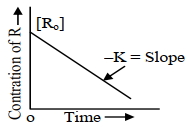
The figure is showing "the variation in concentration against time plot" for a $"y"$ order reaction. The value of $x+y$ is . . . . . . 
| Column $I$ | Column $II$ |
| $(a) \ K_b$ | $(i)$ Elevation in boiling point |
| $(b) \ K_f$ | $(ii)$ Van't Hoff factor |
| $(c) \ i$ | $(iii)$ Cryoscopic constant |
| $(iv)$ Ebullioscopic constant |