MCQ
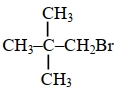
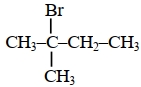
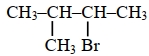
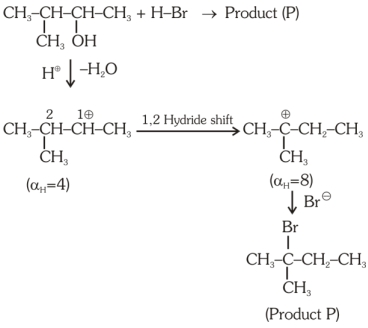
Consider the following reaction and identify the product $(P)$.
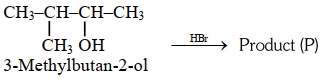
  • A


  • C
    $CH _3 CH = CH - CH _3$
  • D

Answer

Correct option: B.

b

Need a full question paper?

Generate a complete, print-ready paper with questions like this in minutes — across 16+ boards, with answer keys.

Start Generating Free

Similar questions

All those elements belong to $ f - $ block whose atomic numbers are
The total no. of chelate rings in $[Ni(dmg)_2]$ are
Which one of the following orders is wrong with respect to the property indicated
Given below are two statements :

Statement $I$: Aniline reacts with con. $\mathrm{H}_2 \mathrm{SO}_4$ followed by heating at $453-473 \mathrm{~K}$ gives $\mathrm{p}$ aminobenzene sulphonic acid, which gives blood red colour in the 'Lassaigne's test'.

Statement $II$: In Friedel - Craft's alkylation and acylation reactions, aniline forms salt with the $\mathrm{AlCl}_3$ catalyst. Due to this, nitrogen of aniline aquires a positive charge and acts as deactivating group.

In the light of the above statements, choose the correct answer from the options given below :

The reddish brown coloured gas formed when nitric oxide is oxidised by air is
Kolbe's electrolysis of sodium acetate at anode gives
Two solutions of $X$ and $Y$ electrolytes are taken in two beakers and diluted by adding  $500\, mL$ of water. $\Lambda_m$ of $X$ increases by $1.5$ times while that of $Y$ increases by $20$  times, what could be the electrolytes $X$ and $Y$ ?
$1-$ Phenoxypropane is treated with excess of conc. $HI$ at $0\,^oC$ and the  mixture of products is treated with thionyl chloride. The products formed are
Which of the following is least related to the other three?
The reaction, $X + 2Y + Z \to N$ occurs by the following mechanism

$(i)$ $X + Y \rightleftharpoons M$      very rapid equilibrium

$(ii)$ $M + Z \to P$      slow

$(iii)$ $O + Y \to N$      very fast

What is the rate law for this reaction