MCQ
Consider the following reaction

$\begin{array}{*{20}{c}}
{\,\,\,\,\,C{H_3}\,\,\,\,\,\,\,\,\,}\\
{|\,\,\,\,\,\,\,\,\,\,}\\
{C{H_3} - C - O - C{H_3}}\\
{|\,\,\,\,\,\,\,\,\,\,\,}\\
{\,\,\,\,\,\,\,{\kern 1pt} C{H_3}\,\,\,\,\,\,\,\,\,\,\,\,\,}
\end{array}\,\,$ $\xrightarrow[{(1\,Mole)}]{{HI}}$ Products

The main products of reaction will be

  • $\begin{array}{*{20}{c}}
    {\,\,\,\,\,\,\,\,\,\,\,\,\,\,C{H_3}}\\
    {\,\,\,\,\,\,\,\,\,|}\\
    {C{H_3} - C - I}\\
    {\,\,\,\,\,\,\,\,\,\,\,\,|\,\,}\\
    {\,\,\,\,\,\,\,\,\,\,\,\,\,\,\,C{H_3}}
    \end{array}$ $+ CH_3-OH$ 
  • B
    $\begin{array}{*{20}{c}}
    {\,\,\,\,\,\,\,\,\,\,\,\,\,C{H_3}\,\,\,}\\
    {\,\,\,\,\,\,\,|\,\,\,\,}\\
    {C{H_3} - C - OH}\\
    {\,\,\,\,\,\,\,\,\,\,\,\,|\,\,\,\,\,\,\,\,\,}\\
    {\,\,\,\,\,\,\,\,\,\,\,C{H_3}\,\,\,}
    \end{array}$  $ + CH_3I$
  • C
    $\begin{array}{*{20}{c}}
    {\,\,\,\,\,\,\,\,\,\,\,\,\,\,C{H_3}\,\,\,}\\
    {\,\,\,\,\,\,\,|\,\,\,\,}\\
    {C{H_3} - C - OH}\\
    {\,\,\,\,\,\,\,\,\,\,|\,\,\,\,\,\,\,}\\
    {\,\,\,\,\,\,\,\,\,\,\,C{H_3}\,\,\,}
    \end{array}$ $+ CH_3-OH$
  • D
    $\begin{array}{*{20}{c}}
    {\,\,\,\,\,\,\,\,\,\,\,C{H_3}}\\
    \,\,\,\,|\\
    {C{H_3} - CH - I}
    \end{array}$ $+ CH_3 -CH_2 -I$
Answer

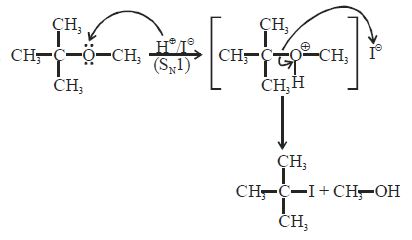
Correct option: A.
$\begin{array}{*{20}{c}}
{\,\,\,\,\,\,\,\,\,\,\,\,\,\,C{H_3}}\\
{\,\,\,\,\,\,\,\,\,|}\\
{C{H_3} - C - I}\\
{\,\,\,\,\,\,\,\,\,\,\,\,|\,\,}\\
{\,\,\,\,\,\,\,\,\,\,\,\,\,\,\,C{H_3}}
\end{array}$ $+ CH_3-OH$ 
a

Need a full question paper?

Generate a complete, print-ready paper with questions like this in minutes — across 16+ boards, with answer keys.

Start Generating Free

Similar questions

Coordination compounds have great importance in biological systems. In this context which of the following statements is incorrect
$\begin{array}{*{20}{c}}
  O \\ 
  {||} \\ 
  {H - C - Cl} 
\end{array}$ is called
On heating acetamide in presence of ${P_2}{O_5},$ which of the following is formed
In which of the following pairs, the outer most electronic configuration will be the same ?
Compound $P$ is neutral. $Q$ gives effervescence with $NaHCO _3$ while $R$ reacts with Hinsbergs reagent to give solid soluble in $NaOH$. Compound $P$ is
The reaction that occurs in a breath analyser, a device used to determine the alcohol level in a person's blood stream is

$2 \mathrm{~K}_{2} \mathrm{Cr}_{2} \mathrm{O}_{7}+8 \mathrm{H}_{2} \mathrm{SO}_{4}+3 \mathrm{C}_{2} \mathrm{H}_{6} \mathrm{O} \rightarrow 2 \mathrm{Cr}_{2}\left(\mathrm{SO}_{4}\right)_{3}+$

$3 \mathrm{C}_{2} \mathrm{H}_{4} \mathrm{O}_{2}+2 \mathrm{~K}_{2} \mathrm{SO}_{4}+11 \mathrm{H}_{2} \mathrm{O}$

If the rate of appearance of $\mathrm{Cr}_{2}\left(\mathrm{SO}_{4}\right)_{3}$ is $2.67 \,\mathrm{~mol}$ $\min ^{-1}$ at a particular time, the rate of disappearance of $\mathrm{C}_{2} \mathrm{H}_{6} \mathrm{O}$ at the same time is ...... $\mathrm{mol}\, \mathrm{min}^{-1}$ (Nearest integer)

Which one of the following will most readily dehydrated in acidic condition
The ratio of $t_{0.75}$ and $t_{0.5}$ for first order reaction is
The functional group which is found in amino acid is
Two complexes $[Cr(H_2O)_6]Cl_3\, (A)$ and $[Cr(NH_3)_6]Cl_3\, (B)$ are violet and yellow coloured respectively. The incorrect statement regarding them is