Question
Consider the following statement regarding a thermocouple:
  1. The neutral temperature does not depend on the temperature of the cold junction.
  2. The inversion temperature does not depend on the temperature of the cold juhction.
  1. Both A and B are correct.
  2. A is correct but a is wrong.
  3. B is correct but A is wrong.
  4. Both A and B are 1trong.

Answer

  1. A is correct but a is wrong.

Explanation:

At cold function :

Qn - Qc = Qi - Qn

where Qn Þ neutral temperture

QÞ inversion temperature

Qc Þ thermo-couple temperature.

Þ The neutral temperature does not depend on the temperature of the cold function.

Þ The inversion temperature does depend on the temperature of the cold function.

Need a full question paper?

Generate a complete, print-ready paper with questions like this in minutes — across 16+ boards, with answer keys.

Start Generating Free

Similar questions

The diameter of ball A is half the diameter of ball B. What will be the ratio of their terminal velocities inside the water?
An observer is stationed at x = 10cm. When a train moves in the y-axis with a velocity 10m/s, what is the apparent frequency?
At Deoprayag (Garhwal, UP) river Alaknanda mixes with the river Bhagirathi and becomes river Ganga. Suppose Alaknanda has a width of 12m, Bhagirathi has a width of 8m and Ganga has a width of 16m. Assume that the depth of water is same in the three rivers. Let the average speed of water in Alaknanda be 20km/h and in Bhagirathi be 16km/h. Find the average speed of water in the river Ganga.
Answer with reason:
In an elastic collision of two billiard balls, is the total kinetic energy conserved during the short time of collision of the balls (i.e., when they are in contact)?
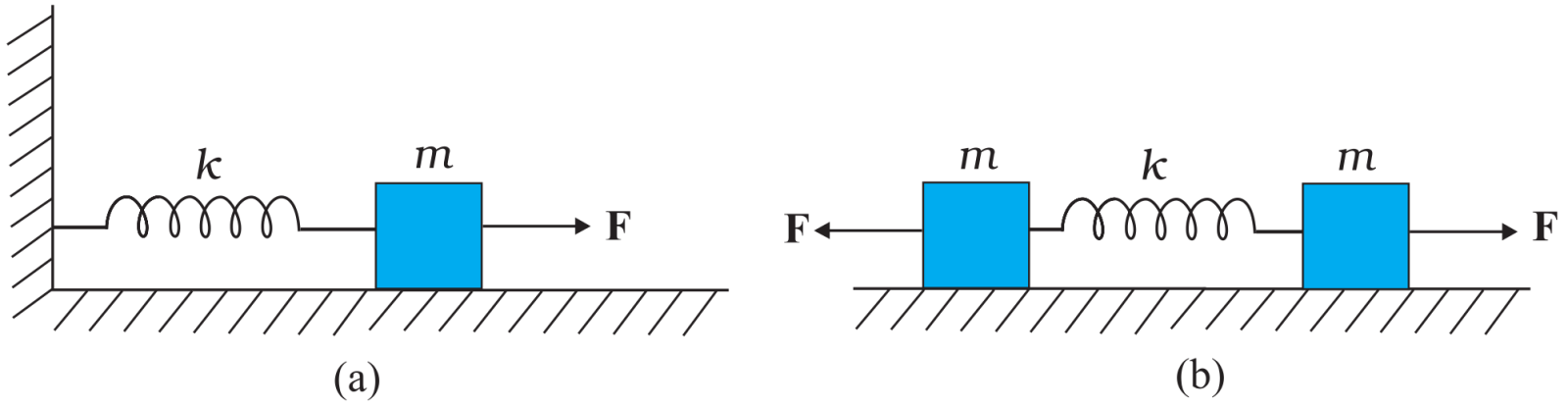
Figure (a) shows a spring of force constant k clamped rigidly at one end and a mass m attached to its free end. A force F applied at the free end stretches the spring. Figure (b) shows the same spring with both ends free and attached to a mass m at either end. Each end of the spring in Fig. (b) is stretched by the same force F.

What is the maximum extension of the spring in the two cases?

Fig. depicts four x-t plots for linear motion of a particle. Which of the plots represent periodic motion? What is the period of motion (in case of periodic motion)?

What is effect on the equilibrium of a physical balance when air is blown below one pan?
The speed of light is 299,792,458m/s.
  1. With respect to the earth.
  2. With respect to the sun.
  3. With respect to a train moving on the earth.
  4. With respect to a spaceship going in outer space.
Which quantity does not change during change of state?
What is the value of work in an isovolumetric process?