Question
Consider the following two statements regarding a linearly polarised, plane electromagnetic wave:
  1. The electric field and the magnetic field have equal average values.
  2. The electric energy and the magnetic energy have equal average values.
  1. Both A and B are true.
  2. A is false but B is true.
  3. B is false but A is true
  4. Both A and B are false.

Answer

  1. Both A and B are true.

Explanation:

For a linearly polarised, plane electromagnetic wave,

$\text{E}=\text{E}_0\sin\omega\Big(\text{t}-\frac{\text{x}}{\text{c}}\Big)$

$\text{B}=\text{B}_0\sin\omega\Big(\text{t}-\frac{\text{x}}{\text{c}}\Big)$

The average value of either E or Bover a cycle is zero (average of $\sin(\theta)$ over a cycle is zero).

Also the electric energy density (UE) and magnetic energy density (UB)are equal.

$\text{u}_\text{E}=\frac{1}{2}\in_0\text{E}^2=\frac{\text{B}^2}{2\mu_0}=\text{u}_\text{B}$

Energy can be found out by integrating energy density over the entire volume of full space. As the energy of the electromagnetic wave is equally shared between electric and magnetic field so their average values will also be equal.

Need a full question paper?

Generate a complete, print-ready paper with questions like this in minutes — across 16+ boards, with answer keys.

Start Generating Free

Similar questions

An AC source rated 100V (rms) supplies a current of 10A (rms) to a circuit. The average power delivered by the source:
If the relative permeability of a substance is 0.999 then its nature is :

There is a solid sphere of radius ‘R’ having uniformly distributed charge. What is the relation between electric field ‘E’ (inside the sphere) and radius of sphere ‘R’ is

(a) E  

(b) E

(c) E     

(d) E

Which of the following is another term for magnetization?
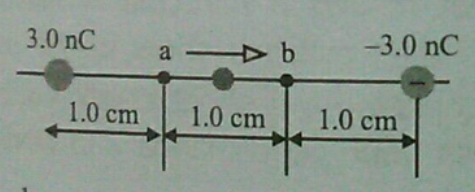
As shown in figure a dust particle with mass m = 5.0 × 10⁻⁹ kg and charge q= 2.0nC starts from rest at point a and moves in a straight line to point b. What is its speed v at point b?

The Einstein’s photo-electric equation is based upon the conservation of:
Which one of following is charge less ?

Five resistors of given values are connected together as shown in the figure. The current in the arm BD will be

(a) Half the current in the arm ABC

(b) Zero

(c) Twice the current in the arm ABC

(d) Four times the current in the arm ABC

A parallel plate condenser with oil between the plates (dielectric constant of oil K = 2) has a capacitance C. If the oil is removed, then capacitance of the capacitor becomes

(a)    

(b) 2C

(c)  

(d)  

In a p-n junction with open ends:
  1. There is no systematic motion of charge carriers.
  2. Holes and conduction electrons systematically go from the p-side to the n-side and from the n side to the p-side respectively.
  3. There is no net charge transfer between the two sides.
  4. There is a constant electric field near the junction.