MCQ
Consider the function $f (x) =$$\left[ \begin{gathered}   \hfill \\   \hfill \\   \hfill \\   \hfill \\   \hfill \\  \end{gathered}  \right.$$\begin{gathered}  \frac{x}{{[x]}}\;\;\;\;\;\;\;\;\;\;\;\;\;if\;\;1 \leqslant \;x < 2 \hfill \\   \hfill \\  1\;\;\;\;\;\;\;\;\;\;\;\;\;\;\;\;if\;\;x = 2 \hfill \\   \hfill \\  \sqrt {6 - x} \;\;\;\;\;\;\;if\;\;2 < x \leqslant 3 \hfill \\ \end{gathered} $ 

where $[x]$ denotes step up function then at $x = 2$ function

  • A
    has missing point removable discontinuity
  • has isolated point removable discontinuity
  • C
    has non removable discontinuity finite type
  • D
    is continuous

Answer

Correct option: B.
has isolated point removable discontinuity
b
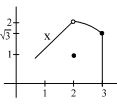
from the figure the function has an obvious removable isolated point discontinuous.

Need a full question paper?

Generate a complete, print-ready paper with questions like this in minutes — across 16+ boards, with answer keys.

Start Generating Free

Similar questions

One ticket is selected at random from $100$ tickets numbered $00, 01, 02, ...... 98, 99$. If $X$ and $Y$ denote the sum and the product of the digits on the tickets, then $P\,(X = 9/Y = 0)$ equals
The general solution of the differential equation $\frac{{dy}}{{dx}} + \frac{2}{x}y = {x^2}$ is
The principal solution of $\tan ^{-1}\left(\tan \left(\frac{7 \pi}{6}\right)\right)$ is
If $A=\left[\begin{array}{cc}0 & 2 \\ 3 & -4\end{array}\right]$ and $k A=\left[\begin{array}{cc}0 & 3 a \\ 2 b & 24\end{array}\right]$, then the values of $k$, $a$ and $b$ respectively are
Let $f(x) = x^3 + px + 1$ and consider following three statements Then

$(i)$ for $p \geqslant  0$ , $f(x) = 0$ has one negative root and $f(x)$ is monotonic

$(ii)$ for $-1 < p < 0$ , $f(x)$ = $0$ has one negative root and $f(x)$ is nonmonotonic
$(iii)$ for $p < 0$ , $f(x)$ = $0$ has three real and distinct roots.

$\int_{\pi /6}^{\pi /3} {\frac{{dx}}{{1 + \sqrt {\tan x} }} = } $
The principal solution of $\sin ^{-1}\left(\sin \left(\frac{5 \pi}{3}\right)\right)$ is
Two person $A$ and $B$ take turns in throwing a pair of dice. The first person to through $9$ from both dice will win the game. If $A$ throws first then the probability that $B$ wins the game is
If $f(x) = cos \left[ {\frac{\pi }{x}} \right] cos \left( {\frac{\pi }{2}\,\,\left( {x\,\, - \,\,1} \right)} \right)$ then $f(x)$ is continuous at :

where $[x]$ is the greatest integerr function of $x$, 

The value of $\lambda$ for which $\int {\frac{{4{x^3} + \lambda {4^x}}}{{{4^x} + {x^4}}}} \,\,dx = \log ({4^x} + {x^4}) + c$ is