Question
Consider the function $f:(0, \infty) \rightarrow R$ defined by $f(x)=e^{-\left|\log _e x\right|}$. If $m$ and $n$ be respectively the number of points at which $f$ is not continuous and $f$ is not differentiable, then $\mathrm{m}+\mathrm{n}$ is
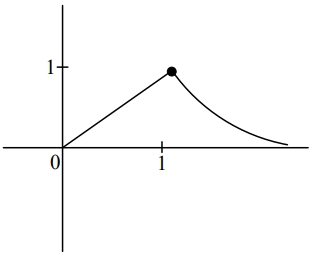
Answer

$f:(0, \infty) \rightarrow R$$ f(x)=e^{-\left|\log _e x\right|}$
$\mathrm{f}(\mathrm{x})=\frac{1}{\mathrm{e}^{\ln x \mid}}=\left\{\begin{array}{l}\frac{1}{\mathrm{e}^{-\ln x}} ; 0 < \mathrm{x} < 1 \\ \frac{1}{\mathrm{e}^{\ln x}} ; \mathrm{x} \geq 1\end{array}\right.$
$\left\{\begin{array}{l}\frac{1}{\frac{1}{x}}=x ; 0 < x < 1 \\ \frac{1}{x}, x \geq 1\end{array}\right.$
${m}=0 \ ($No point at which function is not continuous$)$
${n}=1\ ($Not differentiable$)$
$\therefore \mathrm{m}+\mathrm{n}=1$

Need a full question paper?

Generate a complete, print-ready paper with questions like this in minutes — across 16+ boards, with answer keys.

Start Generating Free

Similar questions

Let $f(\mathrm{x})=\mathrm{x}^5+2 \mathrm{e}^{\mathrm{x} / 4}$ for all $\mathrm{x} \in \mathrm{R}$. Consider a function $g(x)$ such that $(gof) (x)=x$ for all $x \in R$. Then the value of $8 g^{\prime}(2)$ is :
${\sin ^2}\frac{\pi }{8} + {\sin ^2}\frac{{3\pi }}{8} + {\sin ^2}\frac{{5\pi }}{8} + {\sin ^2}\frac{{7\pi }}{8} = $
If $(11)^{27} + (21)^{27}$ when divided by $16$ leaves the remainder
Let $a_{1}, a_{2}, \ldots \ldots, a_{21}$ be an $A.P.$ such that $\sum_{n=1}^{20} \frac{1}{a_{n} a_{n+1}}=\frac{4}{9}$. If the sum of this AP is $189,$ then  $a_{6} \mathrm{a}_{16}$ is equal to :
If $\frac{{3 + 5 + 7 + ..........{\rm{to}}\;n\;{\rm{terms}}}}{{5 + 8 + 11 + .........{\rm{to}}\;10\;{\rm{terms}}}} = 7$, then the value of $n$ is
Number of common tangents of the ellipse  $\frac{{{{\left( {x - 2} \right)}^2}}}{9} + \frac{{{{\left( {y + 2} \right)}^2}}}{4} = 1$ and the circle $x^2 + y^2 -4x + 2y + 4 = 0$ is 
If $I =\frac{2}{\pi} \int_{-\pi / 4}^{\pi / 4} \frac{ dx }{\left(1+ e ^{\sin x}\right)(2-\cos 2 x )}$ then $27 I ^2$ equals. . . . . . . .
If the matrix $A=\left[\begin{array}{ccc}1 & 0 & 0 \\ 0 & 2 & 0 \\ 3 & 0 & -1\end{array}\right]$ satisfies the equation $A ^{20}+\alpha A ^{19}+\beta A =\left[\begin{array}{lll}1 & 0 & 0 \\ 0 & 4 & 0 \\ 0 & 0 & 1\end{array}\right]$ for some real numbers $\alpha$ and $\beta$, then $\beta-\alpha$ is equal to ........ .
If in a $G.P.$ of $64$ terms, the sum of all the terms is $7$ times the sum of the odd terms of the $G.P,$ then the common ratio of the $G.P$. is equal to
The line $2 \mathrm{x}+\mathrm{y}=1$ is tangent to the hyperbola $\frac{\mathrm{x}^2}{\mathrm{a}^2}-\frac{\mathrm{y}^2}{\mathrm{~b}^2}=1$. If this line passes through the point of intersection of the nearest directrix and the $\mathrm{x}$-axis, then the eccentricity of the hyperbola is