MCQ
Consider the hypothetical situation where the azimuthal quantum number, $l$, takes values $0$ , $1,2, \ldots \ldots n+1,$ where $n$ is the principal quantum number. Then, the element with atomic number
  • A
    $13$ has a half$-$filled valence subshell
  • B
    $9$ is the first alkali metal
  • $8$ is the first noble gas
  • D
    $6$ has a $2 p-$ valence subshell

Answer

Correct option: C.
$8$ is the first noble gas
c
$l=0$ to $( n +1)$

$n =1 \quad n =2$

$l=0,1,2 \quad l=0,1,2,3$

$(n+l) \Rightarrow \frac{1 s}{1} \frac{1 p}{2} \frac{1 d}{3} \quad \frac{2 s}{2} \frac{2 p}{3} \frac{2 d}{4} \frac{2 f}{5}$

$n=3$

$l=0,1,2,3,4$

$\frac{3 s }{3} \frac{3 p }{4} \frac{3 d }{5} \frac{3 f }{6} \frac{3 g }{7}$

Now, in order to write electronic configuration, we need to apply $( n +l)$ rule

Energy order : $1 s <1 p <2 s <1 d <2 p <3 s <2 d$

Option 1) $13: 1 s^{2} 1 p^{6} 2 s^{2} 1 d^{3}$ is not half filled

Option 2) $9: \quad 1 s^{2} 1 p^{6} 2 s^{1}$ is the first alkali metal because after losing one electron, it will achieve first noble gas configuration

Option $3)$ $8: \quad 1 s^{2} 1 p^{6}$ is the first noble gas because after $1 p ^{6} e ^{-}$ will

Option $4)$ $6: \quad 1 s ^{2} 1 p ^{4}$ has $1 p$ valence subshell.
Need a full question paper?

Generate a complete, print-ready paper with questions like this in minutes — across 16+ boards, with answer keys.

Start Generating Free

Similar questions

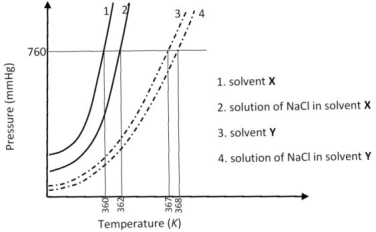
The plot given below shows $P - T$ curves (where $P$ is the pressure and $T$ is the temperature) for two solvents $X$ and $Y$ and isomolal solutions of $NaCl$ in these solvents. $NaCl$ completely dissociates in both the solvents.

On addition of equal number of moles of a non-volatile solute $S$ in equal amount (in $kg$ ) of these solvents, the elevation of boiling point of solvent $X$ is three times that of solvent $Y$. Solute $S$ is known to undergo dimerization in these solvents. If the degree of dimerization is $0.7$ in solvent $Y$, the degree of dimerization in solvent $X$ is. . . . . . .

The quantity of electricity needed to liberate $0.5\,gram$ equivalent of an element is
In which of the following reaction cyanide will be obtained as a major product
Among the following which one can have a meso form?
The normality of orthophosphoric acid having purity of $70\%$ by weight and specific gravity $1.54$ would be ............. $\mathrm{N}$
The major products from the following reaction sequence are product $\mathrm{A}$ and product $\mathrm{B}$. The total sum of $\pi$ electrons in product $A$ and product $B$ are . . . . . . .(nearest integer)
$
\begin{array}{l}
S(g)+\frac{3}{2} O_2(g) \rightarrow SO_3(g)+2 x \text { kcal } \\
SO_2(g)+\frac{1}{2} O_2(g) \rightarrow SO_3(g)+y kcal
\end{array}
$
The heat of formation of $SO _2(g)$ is given by :
The mass of $Mg_3N_2$ produced if $48\, gm$ of $Mg$ metal is reacted with $34\, gm\, NH_3$ gas is
$Mg + NH_3 \to Mg_3N_2 + H_2$
Which of the following will produce the maximum depression in freezing point of its aqueous solution
Stainless steel is an alloy of iron with
