Question
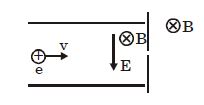
Consider the mass-spectrometer as shown in figure. The electric field between plates is $\vec E\ V/m$ , and the magnetic field in both the velocity selector and in the deflection chamber has magnitude $B$ . Find the radius $'r'$ for a singly charged ion of mass $'m'$ in the deflection chamber 
Answer

$\mathrm{q} \mathrm{E}=\mathrm{q} \mathrm{v} \mathrm{B}$

$\mathrm{qvB}=\frac{\mathrm{mv}^{2}}{\mathrm{r}}$

$r=\frac{m v}{q B}=\frac{m E}{q B^{2}}$

Need a full question paper?

Generate a complete, print-ready paper with questions like this in minutes — across 16+ boards, with answer keys.

Start Generating Free

Similar questions

A planet revolving in elliptical orbit has

$(A)$ a constant velocity of revolution.

$(B)$ has the least velocity when it is nearest to the sun.

$(C)$ its areal velocity is directly proportional to its velocity.

$(D)$ areal velocity is inversely proportional to its velocity.

$(E)$ to follow a trajectory such that the areal velocity is constant.

Choose the correct answer from the options given below

The particle that possesses half integral spin as
An ideal gas has volume ${V_0}$ at ${27^o}C.$ It is heated at constant pressure so that its volume becomes $2{V_0}.$ The final temperature is
The distance of a particle moving on a circle of radius $12 \,m$ measured from a fixed point on the circle and measured along the circle is given by $s=2 t^3$ (in meters). The ratio of its tangential to centripetal acceleration at $t=2 \,s$ is .........
Light of frequency v is incident on a substance of threshold frequency $v_0$($v_0$ $< v)$. The energy of the emitted photo-electron will be
The strength of the magnetic field in which the magnet of a vibration magnetometer is oscillating is increased $4$ times its original value. The frequency of oscillation would then become
The time period of a satellite, revolving above earth's surface at a height equal to $R$ will be (Given $g =\pi^2 m / s ^2, R =$ radius of earth)
Find equivalent resistance between $A$ and $B$
A particle of charge $-q$ and mass $m$ moves in a circle of radius $r$ around an infinitely long line charge of linear density $+\lambda$. Then time period will be given as

(Consider $k$ as Coulomb's constant)

A small block starts slipping down from a point $B$ on an inclined plane $A B,$ which is making an angle $\theta$ with the horizontal section $BC$ is smooth and the remaining section $CA$ is rough with a coefficient of friction $\mu .$ It is found that the block comes to rest as it reaches the bottom (point $A)$ of the inclined plane. If $B C=2A C$, the coefficient of friction is given by $\mu=k \tan \theta$ .The value of $k$ is