Question
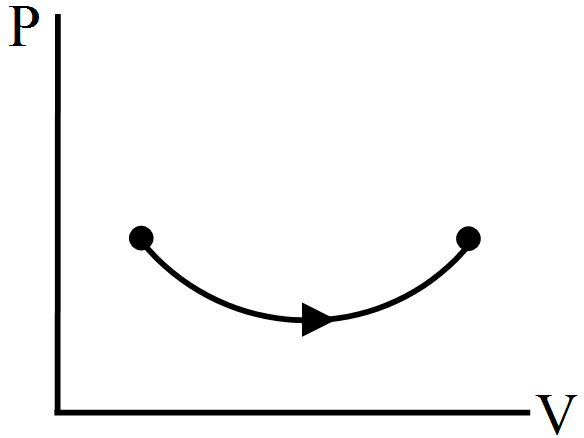
Consider the process on a system shown in figure. During the process, the work done by the system:
  1. Continuously increases.
  2. Continuously decreases.
  3. First increases then decreases.
  4. First decreases then increases.

Answer

  1. Continuously increases.

Explanation:

Work done by a system, $\text{W}=\int\text{PdV}$

Here,

P = Pressure on the system

dV = change in volume

Since dV is positive, i.e. the volume is continuously increasing, work done by the system also continuously increases.

Need a full question paper?

Generate a complete, print-ready paper with questions like this in minutes — across 16+ boards, with answer keys.

Start Generating Free

Similar questions

If the inductance and capacitance are both doubled in L - C - R circuit, the resonant frequency of the circuit will:

In beta decay

(a) The parent and daughter nuclei have same number of protons

(b) The daughter nucleus has one proton less than the parent nucleus

(c) The daughter nucleus has one proton more than the parent nucleus

(d) The daughter nucleus has one neutron more than the parent nucleus

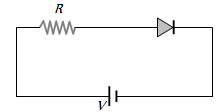
For the given circuit of PN-junction diode, which of the following statement is correct

(a) In forward biasing the voltage across R is V

(b) In forward biasing the voltage across R is 2V

(c) In reverse biasing the voltage across R is V

(d) In reverse biasing the voltage across R is 2V

The phenomenon of light passing through the object is called:

Which of the following relation is significant for metals when the temperature increases?
A particle of mass m is attached to a light string of length l, the other end of which is fixed. Initially the string is kept horizontal and the particle is given an upward velocity v. The particle is just able to complete a circle.
  1. The string becomes slack when the particle reaches its highest point.
  2. The velocity of the particle become zero at the highest point.
  3. The kinetic energy of the ball in initial position was $\frac{1}{2}\text{m}\nu^2=\text{mgl}.$
  4. The particle again passes through the initial position.

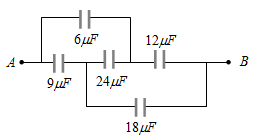
In the connections shown in the adjoining figure, the equivalent capacity between A  and  B will be

(a) 10.8 μF

(b) 69 μF

(c) 15 μF

(d) 10 μF

A set of atoms in an excited state decay.

A current of 2 A flows in a system of conductors as shown. The potential difference (  will be

(a) +2V

(b) +1V

(c) -1V

(d) -2V

A long, straight wire carries a current i. The magnetizing field intensity H is measured at a point P close to the wire. A long, cylindrical iron rod is brought close to the wire so that the point P is at the centre the rod. The value of H at P will:
  1. Increase many times.
  2. Decrease many times
  3. Remain almost constant.
  4. Become zero.