MCQ
Consider the reaction

$KOH + {O_3} \to coloured\,solid\,(a) + Gas\,(b) + {H_2}O$ 

Select $CORRECT$ statement

  • A
    $(a)$ is diamagnetic
  • B
    $(b)$ does not react directly with $Xe$
  • $(a)$ gives no gas with dil. $HCl$
  • D
    $(b)$ is best absorbed by $H_2O$

Answer

Correct option: C.
$(a)$ gives no gas with dil. $HCl$
c
$S-S$

Need a full question paper?

Generate a complete, print-ready paper with questions like this in minutes — across 16+ boards, with answer keys.

Start Generating Free

Similar questions

During electrolysis, the species discharged at cathode are
Identify the incorrect statement for $PCl _{5}$ from the following.
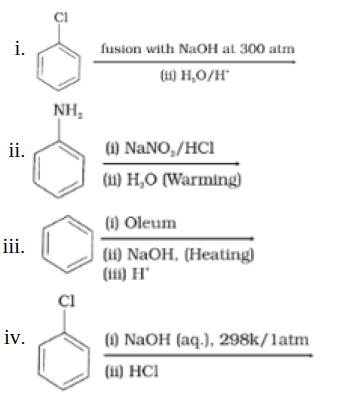
Which of the following reactions will yield phenol?
Image
Two solutions $A $ and $B$ are separated by semi- permeable membrane. If liquid flows form $ A $ to $ B$ then]
A catalyst lowers the activation energy for a certain reaction from $83.314$ to $75 \,KJ\,mol^{-1}$ at $500\,K$ . What will be the rate of reaction as compare to uncatalysed reaction ? Assume other things being equal ....... $times$
Assuming that the seventh period is $32$ members long, what should be the atomic number of the noble gas following radon $(Rn)?$
Consider an electrochemical cell: $A ( s )\left| A ^{ n +}( aq , 2 M ) \| B ^{2 n +}( aq , 1 M )\right| B ( s )$. The value of $\Delta H ^{\ominus}$ for the cell reaction is twice that of $\Delta G ^{\ominus}$ at $300 K$. If the emf of the cell is zero,  the $\Delta S ^{\ominus}$ (in $J K ^{-1} mol ^{-1}$ ) of the cell reaction per mole of $B$ formed at $300 K$ is. . . . . . . (Given: $\ell n (2)=0.7, R$ (universal gas constant) $=8.3 J K ^{-1} mol ^{-1} . H , S$ and $G$ are enthalpy, entropy and Gibbs energy, respectively.)
$3-$ Hydroxybutanal is formed when $X$ reacts with $Y$ in dilute $Z$ solution. What are $X, Y$ and $Z$ ?

$X-Y-Z$

Which of the following procedures would be best for achieving the following reaction ?
Which is the correct thermal stablity order for $\mathrm{H}_{2} \mathrm{E}(\mathrm{E}=\mathrm{O}, \mathrm{S}, \mathrm{Se}, \text { Te and Po) } ?$