MCQ
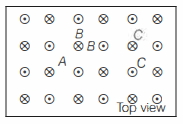
Consider the regular array of vertical identical current carrying wires (with direction of current flow as indicated in the figure alongside) protruding through a horizontal table. If we scatter some diamagnetic particles on the table, then they are likely to accumulate
  • around regions such as $A$
  • B
    around regions such as $B$
  • C
    in circular regions around individual wires such as $C$
  • D
    uniformly everywhere

Answer

Correct option: A.
around regions such as $A$
a
(a)

A diamagnetic material tries to expel field lines from its volume and therefore experiences a repulsion when placed in region of strong fields. In given arrangement, field is zero in region marked $A$. So, diamagnetic powder accumulates in region $A$.

Need a full question paper?

Generate a complete, print-ready paper with questions like this in minutes — across 16+ boards, with answer keys.

Start Generating Free

Similar questions

When a hydrogen atom is raised from the ground state to an excited state
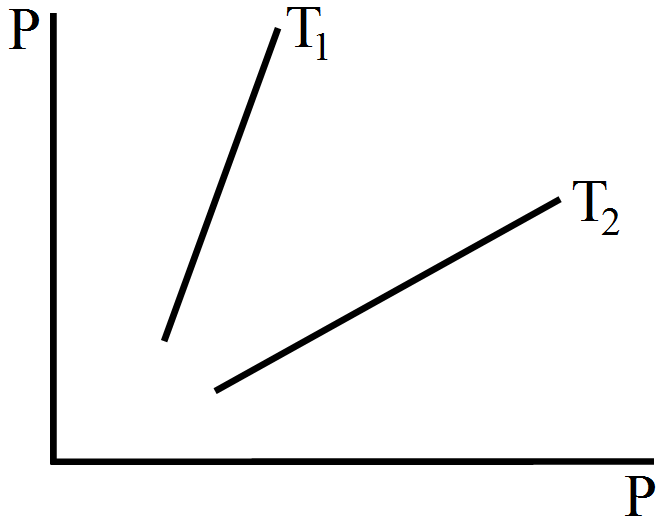
Figure. shows graphs of pressure vs density for an ideal gas at two temperatures $T_1$ and $T_2$.
An electric bulb illuminates a plane surface. The intensity of illumination on the surface at a point $2$ m away from the bulb is $5 \times 10^{-4}$ phot (lumen/ $cm ^2$ ). The line joining the bulb to the point makes an angle of $60^{\circ}$ with the normal to the surface. The intensity of the bulb in candela is
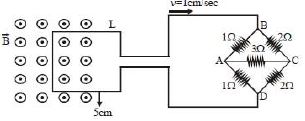
The figure shows a square loop $L$ of side $5\, cm$ which is connected to a network of resistances. The whole set up is moving towards right with a constant speed of $1\, cms^{-1}$. At some instant, a part of $L$ is in a uniform magnetic field of $1\, T$, perpendicular to the plane of the loop. If the resistance of $L$ is $1.7\,\Omega $, the current in the loop at that instant will be close to.....$\mu A$
The oscillating electric and magnetic vectors of an electromagnetic wave are oriented along
Which of the following does not fit into a group:
The potential difference applied to an $X-$ ray tube is increased. As a result, in the emitted radiation :
A concave mirror of focal length $f_1$ is palced at a distane of $d$ from a convex lens of focal length $f_2$ . A beam of light coming from infinity and falling on his convex lens - concave mirror combination returns to infinity . The distance $d$ must equal 
In which of the following series, does the $121.5\ nm$ line of the spectrum of the hydrogen atom lie?
Using a bar magnet P, a vibration magnetometer has time period 2seconds. When a bar Q (identical to P in mass and size) is placed on top of P, the time period is unchanged. Which of the following statements is true