Question
Consider the situation of the previous problem.
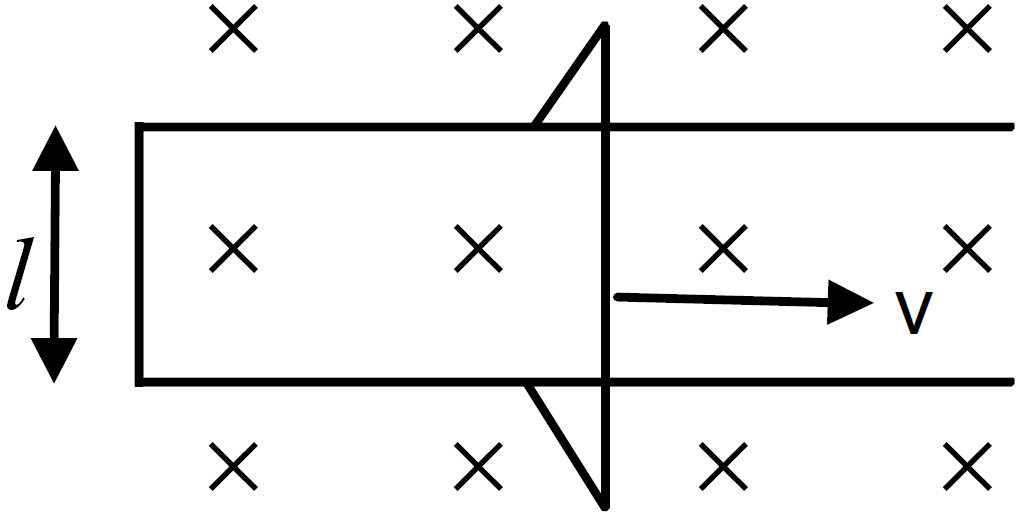
  1. Calculate the force needed to keep the sliding wire moving with a constant velocity $v$.
  2. If the force needed just after $t = 0$ is $F_0$, find the time at which the force needed will be $\frac{\text{F}_0}{2}.$
Answer


$\text{e}=\text{Bvl}$
$\text{i}=\frac{\text{e}}{\text{R}}=\frac{\text{Bvl}}{2\text{r}(\text{l}+\text{vt})}$
  1. $\text{F}=\text{ilB}=\frac{\text{Bvl}}{2\text{r}(\text{l}+\text{vt})}\times\text{lB}=\frac{\text{B}^2\text{l}^2\text{v}}{2\text{r}(\text{l}+\text{vt})}$
  2. Just after $\text{t}=0$
$\text{f}_0=\text{ilB}=\text{lB}\Big(\frac{\text{lBv}}{2\text{rl}}\Big)=\frac{\text{l}\text{B}^2\text{v}}{2\text{r}}$
$\frac{\text{f}_0}{2}=\frac{\text{l}\text{B}^2\text{v}}{4\text{r}}=\frac{\text{l}^2\text{B}^2\text{v}}{2\text{r}(\text{l}+\text{vt})}$
$\Rightarrow2\text{l}=\text{l}+\text{vt}$
$\Rightarrow\text{T}=\frac{\text{l}}{\text{v}}$

Need a full question paper?

Generate a complete, print-ready paper with questions like this in minutes — across 16+ boards, with answer keys.

Start Generating Free

Similar questions

Separation of Motion of a system of particles into motion of the centre of mass and motion about the centre of mass: Show $\text{L}=\text{L}'+\text{R}\times\text{MV}$ where $\text{L}'=\sum\text{r}'_\text{i}\times\text{p}'_\text{i}$ is the angular momentum of the system about the centre of mass with velocities taken relative to the centre of mass. Remember $\text{r}'_\text{i}=\text{r}_\text{i}-\text{R},$ rest of the notation is the standard notation used in the chapter.
Note: $\text{L}'$ and $\text{MR}\times\text{V}$ can be said to be angular momenta, respectively, about and of the centre of mass of the system of particles.
Find the mutual inductance between the straight wire and the square loop of figure.
A mass m is placed at P a distance h along the normal through the centre O of a thin circular ring of mass M and radius r

If the mass is removed further away such that OP becomes 2h, by what factor the force of gravitation will decrease, if h = r?
Describe stress-strain relationship for a loaded steel wire and hence explain the terms : Elastic limit, yield point, tensile strength.
A neutron (um/ s) collides with a nucleus at rest of mass number A. How muchenergy is transferred to the nucleus by the neutron?
Repeat the previous problem if the particle C is displaced through a distance x along the line AB.
Calculate the heat required to convert $3 kg$ of ice at $-12{ }^{\circ} C$ kept in a calorimeter to steam at $100^{\circ} C$ at atmospheric pressure. Given specific heat capacity of ice $=2100 J kg ^{-1} K ^{-1}$, specific heat capacity of water $=4186 J ^{-1} Kg ^{-1}$, latent heat of fusion of ice $=3.35 \times 10^5 J kg ^{-1}$ and latent heat of steam $=2.256 \times 10^6 J kg ^{-1}$.
Find the expression for kinetic energy, potential energy and total energy of a particle executing SHM.
The position, velocity and acceleration of a particle executing simple harmonic motion are found to have magnitudes $2cm, 1m/s$ and $10m/s^2$​​​​​​​ at a certain instant. Find the amplitude and the time period of the motion.
A narrow sound pulse (for example, a short pip by a whistle) is sent across a medium.
(a) Does the pulse have a definite,
  1. frequency,
  2. wavelength,
  3. speed of propagation?
(b) If the pulse rate is 1 after every 20s, (that is the whistle is blown for a split of second after every 20s), is the frequency of the note produced by the whistle equal to 1/20 or 0.05Hz?