Question
Consider the situation of the previous problem.
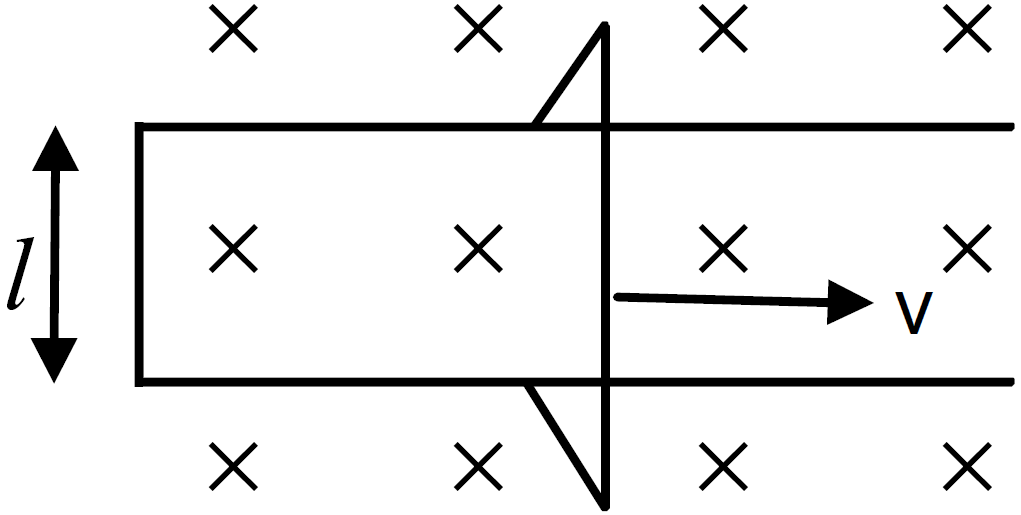
  1. Calculate the force needed to keep the sliding wire moving with a constant velocity v.
  2. If the force needed just after t = 0 is F0, find the time at which the force needed will be $\frac{\text{F}_0}{2}.$
Answer

$\text{e}=\text{Bvl}$

$\text{i}=\frac{\text{e}}{\text{R}}=\frac{\text{Bvl}}{2\text{r}(\text{l}+\text{vt})}$

  1. $\text{F}=\text{ilB}=\frac{\text{Bvl}}{2\text{r}(\text{l}+\text{vt})}\times\text{lB}=\frac{\text{B}^2\text{l}^2\text{v}}{2\text{r}(\text{l}+\text{vt})}$
  2. Just after $\text{t}=0$

$\text{f}_0=\text{ilB}=\text{lB}\Big(\frac{\text{lBv}}{2\text{rl}}\Big)=\frac{\text{l}\text{B}^2\text{v}}{2\text{r}}$

$\frac{\text{f}_0}{2}=\frac{\text{l}\text{B}^2\text{v}}{4\text{r}}=\frac{\text{l}^2\text{B}^2\text{v}}{2\text{r}(\text{l}+\text{vt})}$

$\Rightarrow2\text{l}=\text{l}+\text{vt}$

$\Rightarrow\text{T}=\frac{\text{l}}{\text{v}}$

Need a full question paper?

Generate a complete, print-ready paper with questions like this in minutes — across 16+ boards, with answer keys.

Start Generating Free

Similar questions

A vector has both magnitude and direction. Does it mean that anything that has magnitude and direction is necessarily a vector? The rotation of a body can be specified by the direction of the axis of rotation, and the angle of rotation about the axis. Does that make any rotation a vector?
Determine the poission's ratio of the material of wire whose volume remains constant under an external normal stress.
A proton goes undeflected in a crossed electric and magnetic field (the fields are perpendicular to each other) at a speed of 2.0 × 10⁵ms-1. The velocity is perpendicular to both the fields. When the electric field is switched off, the proton moves along a circle of radius 4.0cm. Find the magnitudes of the electric and magnetic fields. Take the mass of the proton = 1.6 × 10⁻²⁷kg
It is required to construct a $10\mu\text{F}$ capacitor which can be connected across a 200V battery. Capacitors of capacitance $10\mu\text{F}$ are available but they can withstand only 50V. Design a combination which can yield the desired result.
An object of mass m is raised from the surface of the earth to a height equal to the radius of the earth, that is, taken from a distance R to 2R from the centre of the earth. What is the gain in its potential energy?
One end of a long string of linear mass density 8.0 × 10⁻³kg m–1 is connected to an electrically driven tuning fork of frequency 256Hz. The other end passes over a pulley and is tied to a pan containing a mass of 90kg. The pulley end absorbs all the incoming energy so that reflected waves at this end have negligible amplitude. At t = 0, the left end (fork end) of the string x = 0 has zero transverse displacement (y = 0) and is moving along positive y-direction. The amplitude of the wave is 5.0cm. Write down the transverse displacement y as function of x and t that describes the wave on the string.
A sample of an ideal gas $(\gamma=1.5)$ is compressed adiabatically from a volume of 150cm3 to 50cm3. The initial pressure and the initial temperature are 150kPa and 300K. Find,
  1. The number of moles of the gas in the sample.
  2. The molar heat capacity at constant volume.
  3. The final pressure and temperature.
  4. The work done by the gas in the process.
  5. The change in internal energy of the gas.
A hot air balloon is a sphere of radius 8m. The air inside is at a temperature of 60°C. How large a mass can the balloon lift when the outside temperature is 20°C? (Assume air is an ideal gas, R = 8.314J mole-1K-1, 1 atm. = 1.013 × 10⁵ Pa the membrane tension is 5N m-1)
Refer to the graphs in Fig. Match the following.
Graph
 
Characteristic
a.
i.
has v > 0 and a < 0 throughout.
b.
ii.
has x > 0 throughout and has a point with v = 0 and a point with a = 0.
c.
iii.
has a point with zero displacement for t > 0.
d.
iv.
has v < 0 and a > 0.
A U-shaped wire is placed before a concave mirror having radius of curvature 20cm. Find the total length of the image.