Question
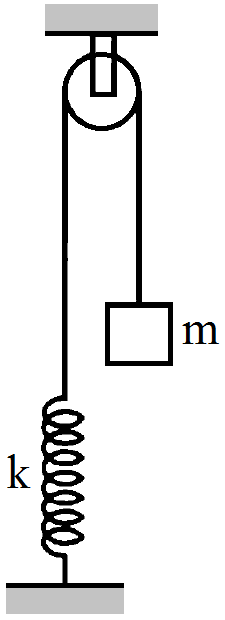
Consider the situation shown in figure. Initially the spring is unstretched when the system is released from rest. Assuming no friction in the pulley, find the maximum elongation of the spring.
Answer

Mass of the body = m

Let the elongation be x

So, $\frac{1}{2}\text{kx}^2=\text{mgx}$

$\Rightarrow\text{x}=2\text{mg}/\text{k}$
Need a full question paper?

Generate a complete, print-ready paper with questions like this in minutes — across 16+ boards, with answer keys.
Start Generating Free

Similar questions

A tightly closed metal lid of a glass bottle can be opened more easily if it is put in hot water for some time. Explain.
A wire of 15 $\Omega$ resistance is gradually stretched to double its original length. It is then cut into two equal parts. These parts are then connected in parallel across a 3.0 volt battery. Find the current drawn from the battery.
A farsighted person cannot see objects placed closer to 50cm. Find the power of the lens needed to see the objects at 20cm.
At what separation should two equal charges, 1.0C each, be placed so that the force between them equals the weight of a 50kg person?
For a photosensitive surface, threshold wavelength is $\lambda_0.$ Does photoemission occur if the wavelength of radiation is (i) more than $\lambda_0$ and (ii) less than $\lambda_0?$ Justify your answer.
A sample of HCl gas is placed in an electric field of $3 \times 10^4 N / C$. The dipole moment of each molecule of HCl is $6 \times 10^{-30} C \times m$. What will be the maximum torque acting on the molecule?
Find the greatest length of an organ pipe open at both ends that will have its fundamental frequency in the normal hearing range (20Hz-20,000Hz). Speed of sound in air = 340m/s.
Mention important results regarding electrostatics of conductors.
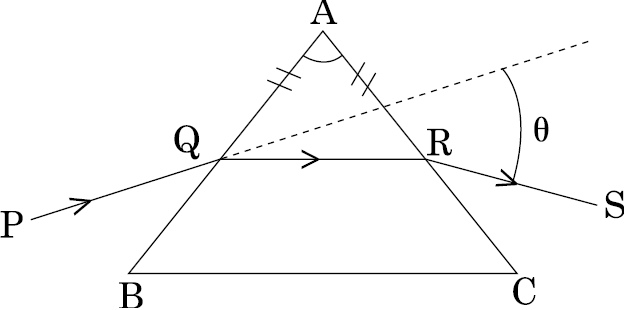
A ray PQ incident on the refracting face BA is refracted in the prism BAC as shown in the figure and emerges from the other refracting face AC as RS such that AQ = AR. If the angle of prism A = 60o and refractive index of material of prism is$\sqrt{3}$, calculate angle $\theta.$

A compound microscope forms an inverted image of an object. In which of the following cases it is kely to create difficulties?
  1. Looking at small germs.
  2. Looking at circular spots.
  3. Looking at a vertical tube containing some water.