MCQ
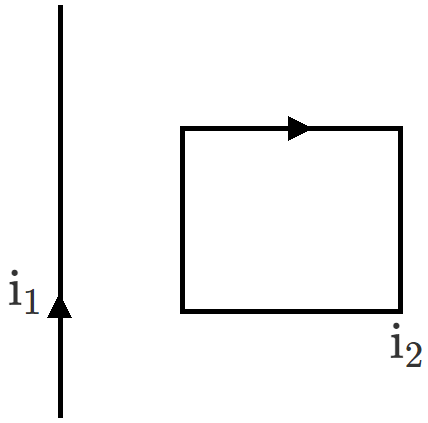
Consider the situation shown in figure. The straight wire is fixed but the loop can move under magnetic force. The loop will:
  • A
    Remain stationary.
  • Move towards the wire.
  • C
    Move away from the wire.
  • D
    Rotate about the wire.

Answer

Correct option: B.
Move towards the wire.
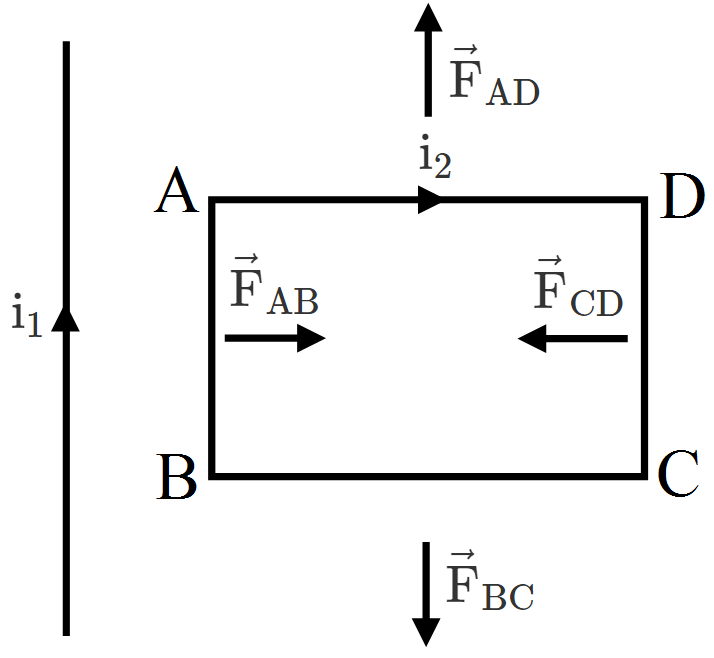
$\overrightarrow{\text{F}}_\text{AD}+\overrightarrow{\text{F}}_\text{BC}=0$
$\overrightarrow{\text{F}}_\text{AB}>\overrightarrow{\text{F}}_\text{CD}$
Force acting on the wire per unit length carrying current $i_2$ due to the wire carrying current $i_1$ placed at $a$ distance $d$ is given by,
$\text{F}=\frac{\mu_0\text{i}_1\text{i}_2}{2\pi\text{d}}$
So, forces per unit length acting on sides $AB$ and $CD$ are as follows:
$\text{F}_\text{AB}=\frac{\mu_0\text{i}_1\text{i}_2}{2\pi\text{d}} \ ($Towards the wire$)$
$\text{F}_\text{CD}=\frac{\mu_0\text{i}_1\text{i}_2}{2\pi(\text{d}+\text{a})} \ ($Away from the wire$)$
Here, $F_{AB} > F_{CD}$ because force is inversly proportional to the distance from the wire and wire $AB$ is closer to the wire carrying current $i_{1.}$
The forces per unit length acting on sides $BC$ and $DA$ will be equal and opposite, as they are equally away from the wire carrying current $i_1,$ with current $i_2$ flowing in the opposite direction.
$\therefore\text{F}_\text{BC}=-\text{F}_\text{DA}$
Now,
Net force:
$\text{F} = \text{F}_\text{AB}+\text{F}_\text{BC}+\text{F}_\text{CD}+\text{F}_\text{DA}$
$\Rightarrow\text{F}=\frac{\mu_0\text{i}_1\text{i}_2}{2\pi\text{d}}+\text{F}_\text{BC}-\frac{\mu_0\text{i}_1\text{i}_2}{2\pi(\text{d+a})}-\text{F}_\text{BC}$
$\Rightarrow\text{F}=\frac{\mu_0\text{i}_1\text{i}_2}{2\pi}\Big(\frac{1}{\text{d}}-\frac{1}{\text{d+a}}\Big)$
$\Rightarrow\text{F}=\frac{\mu_0\text{i}_1\text{i}_2\text{a}}{2\pi\text{d}(\text{d+a})}$
$($Towards the wire$)$
Therefore, the loop will move towards the wire.

Need a full question paper?

Generate a complete, print-ready paper with questions like this in minutes — across 16+ boards, with answer keys.

Start Generating Free

Similar questions

An object 1 cm tall is placed 4cm infront of a mirror. In order to produce an upright image of 3cm  height one needs a(a) Convex mirror of radius of curvature 12 cm (b) Concave mirror of radius of curvature 12 cm(c) Concave mirror of radius of curvature 4 cm(d) Plane mirror of height 12 cm


The wavelength of a photon needed to remove a proton from a nucleus which is bound to the nucleus with $1\ MeV$ energy is nearly:
Least doped region in a transistor(a) Either emitter or collector(b) Base(c) Emitter(d) Collector
       
A horizontal circular loop carries a current that looks clockwise when viewed from above. It is replaced by an equivalent magnetic dipole consisting of a south pole S and a north pole N:
When you speak to your friend, which of the following parameters have a unique value in the sound produced?
  1. Frequency.
  2. Wavelength.
  3. Amplitude.
  4. Wave velocity.
Maximum value of voltage in an ac circuit is 282 V. The effective magnitude of voltage is:
The angular velocity of the engine (and hence of the wheel) of a scooter is proportional to the petrol input per second. The scooter is moving on a frictionless road with uniform velocity. If the petrol input is increased by 10%, the linear velocity of the scooter is increased by:
  1. 50%
  2. 10%
  3. 20%
  4. 0%
Which of the following is not a consequence of Gauss’s law?
Assertion  :  In transistor common emitter mode as an amplifier is preferred over common base mode.
Reason     : In common emitter mode the input signal is connected in series with the voltage applied to the base emitter function.(a) If both assertion and reason are true and the reason is the correct explanation of the assertion.(b) If both assertion and reason are true but reason is not the correct explanation of the assertion.(c) If assertion is true but reason is false.(d) If the assertion and reason both are false.


A Young's double slit experiment is performed with white light: