MCQ
Consider the situation shown in figure. The straight wire is fixed but the loop can move under magnetic force. The loop will:
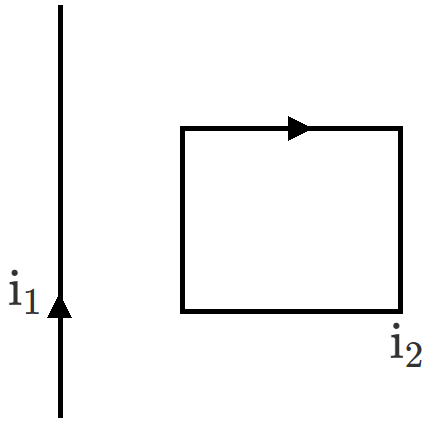
- ARemain stationary.
- BMove towards the wire.
- CMove away from the wire.
- DRotate about the wire.
Explanation:
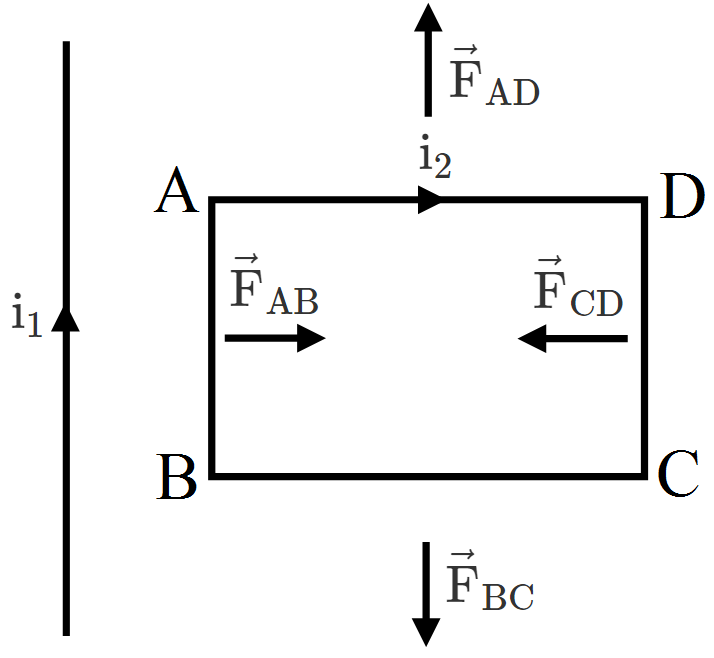
$\overrightarrow{\text{F}}_\text{AD}+\overrightarrow{\text{F}}_\text{BC}=0$
$\overrightarrow{\text{F}}_\text{AB}>\overrightarrow{\text{F}}_\text{CD}$
Force acting on the wire per unit length carrying current i2 due to the wire carrying current i1 placed at a distance d is given by,
$\text{F}=\frac{\mu_0\text{i}_1\text{i}_2}{2\pi\text{d}}$
So, forces per unit length acting on sides AB and CD are as follows:
$\text{F}_\text{AB}=\frac{\mu_0\text{i}_1\text{i}_2}{2\pi\text{d}}$ (Towards the wire)
$\text{F}_\text{CD}=\frac{\mu_0\text{i}_1\text{i}_2}{2\pi(\text{d}+\text{a})}$ (Away from the wire)
Here, FAB > FCD because force is inversly proportional to the distance from the wire and wire AB is closer to the wire carrying current i1.
The forces per unit length acting on sides BC and DA will be equal and opposite, as they are equally away from the wire carrying current i1, with current i2 flowing in the opposite direction.
$\therefore\text{F}_\text{BC}=-\text{F}_\text{DA}$
Now,
Net force:
$\text{F} = \text{F}_\text{AB}+\text{F}_\text{BC}+\text{F}_\text{CD}+\text{F}_\text{DA}$
$\Rightarrow\text{F}=\frac{\mu_0\text{i}_1\text{i}_2}{2\pi\text{d}}+\text{F}_\text{BC}-\frac{\mu_0\text{i}_1\text{i}_2}{2\pi(\text{d+a})}-\text{F}_\text{BC}$
$\Rightarrow\text{F}=\frac{\mu_0\text{i}_1\text{i}_2}{2\pi}\Big(\frac{1}{\text{d}}-\frac{1}{\text{d+a}}\Big)$
$\Rightarrow\text{F}=\frac{\mu_0\text{i}_1\text{i}_2\text{a}}{2\pi\text{d}(\text{d+a})}$
(Towards the wire)
Therefore, the loop will move towards the wire.
Generate a complete, print-ready paper with questions like this in minutes — across 16+ boards, with answer keys.
A 60 watt bulb operates on 220V supply. The current flowing through the bulb is
|
(a) 11/3 amp |
(b) 3/11 amp |
(c) 3 amp |
(d) 6 amp |
The pointer of a dead-beat galvanometer gives a steady deflection because
|
(a) Eddy currents are produced in the conducting frame over which the coil is wound |
|
(b) Its magnet is very strong |
|
(c) Its pointer is very light |
|
(d) Its frame is made of abonite |
Which of the following is quantised according to Bohr’s theory of hydrogen atom
| (a) Linear momentum of electron | (b) Angular momentum of electron |
| (c) Linear velocity of electron | (d) Angular velocity of electron |
A normally incident ray reflected at an angle of 90°. The value of critical angle is
|
(a) 45° |
(b) 90° |
(c) 65° |
(d) 43.2° |