MCQ
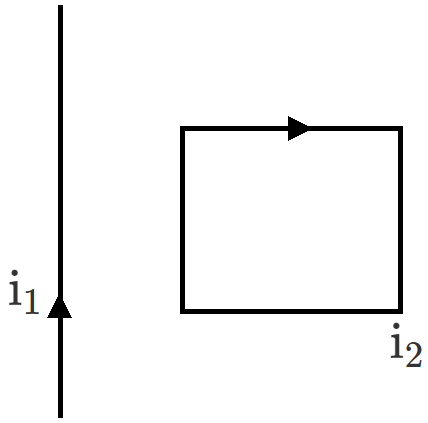
Consider the situation shown in figure. The straight wire is fixed but the loop can move under magnetic force. The loop will:
  • A
    Remain stationary.
  • Move towards the wire.
  • C
    Move away from the wire.
  • D
    Rotate about the wire.

Answer

Correct option: B.
Move towards the wire.

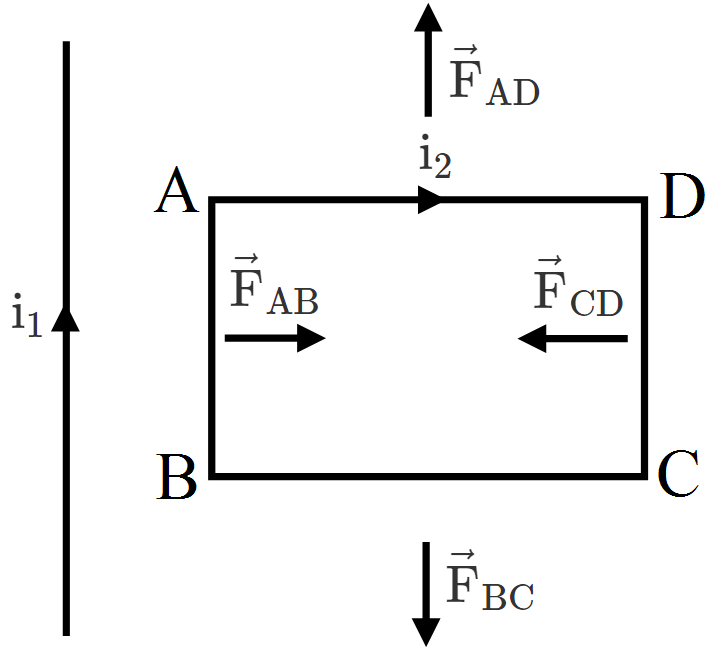
$\overrightarrow{\text{F}}_\text{AD}+\overrightarrow{\text{F}}_\text{BC}=0$
$\overrightarrow{\text{F}}_\text{AB}>\overrightarrow{\text{F}}_\text{CD}$
Force acting on the wire per unit length carrying current $i_2$ due to the wire carrying current $i_1$ placed at a distance $d$ is given by,
$\text{F}=\frac{\mu_0\text{i}_1\text{i}_2}{2\pi\text{d}}$
So, forces per unit length acting on sides $AB$ and $CD$ are as follows:
$\text{F}_\text{AB}=\frac{\mu_0\text{i}_1\text{i}_2}{2\pi\text{d}} ($Towards the wire$)$
$\text{F}_\text{CD}=\frac{\mu_0\text{i}_1\text{i}_2}{2\pi(\text{d}+\text{a})} ($Away from the wire$)$
Here, $F_{AB} > F_{CD}$ because force is inversly proportional to the distance from the wire and wire $AB$ is closer to the wire carrying current $i_1$.
The forces per unit length acting on sides $BC$ and $DA$ will be equal and opposite, as they are equally away from the wire carrying current $i_1$, with current $i_2$ flowing in the opposite direction.
$\therefore\text{F}_\text{BC}=-\text{F}_\text{DA}$
Now,
Net force:
$\text{F} = \text{F}_\text{AB}+\text{F}_\text{BC}+\text{F}_\text{CD}+\text{F}_\text{DA}$
$\Rightarrow\text{F}=\frac{\mu_0\text{i}_1\text{i}_2}{2\pi\text{d}}+\text{F}_\text{BC}-\frac{\mu_0\text{i}_1\text{i}_2}{2\pi(\text{d+a})}-\text{F}_\text{BC}$
$\Rightarrow\text{F}=\frac{\mu_0\text{i}_1\text{i}_2}{2\pi}\Big(\frac{1}{\text{d}}-\frac{1}{\text{d+a}}\Big)$
$\Rightarrow\text{F}=\frac{\mu_0\text{i}_1\text{i}_2\text{a}}{2\pi\text{d}(\text{d+a})}$
$($Towards the wire$)$
Therefore, the loop will move towards the wire.

Need a full question paper?

Generate a complete, print-ready paper with questions like this in minutes — across 16+ boards, with answer keys.

Start Generating Free

Similar questions

An object is placed at the focus of concave lens having focal length $f$. What is the magnification and distance of the image from the optical centre of the lens?
The intrinsic semiconductor becomes an insulator at
An electron changes its position from orbit $n = 4$ to the orbit $n = 2$ of an atom. The wavelength of the emitted radiation’s is ($R =$ Rydberg’s constant)
Astigmatism (for a human eye) can be removed by using
The voltage of an $ac$ supply varies with time $(t)$  as $V = 120\sin 100\,\pi \,t\cos 100\pi \,t.$ The maximum voltage and frequency respectively are
$AB$ is an object dipped in water at a depth of $d$ . Its length is $l$ . It is seen from air at near normal incidence. The length of the image is
A boy of mass M is applying a horizontal force to slide a box of mass M' on a rough horizontal surface. The coefficient of friction between the shoes of the box and the floor is $\mu.$ In which of the following cases it is certainly not possible to slide the box?
A nuclear power plant supplying electrical power to a village uses a radioactive material of half life $T$ years as the fuel. The amount of fuel at the beginning is such that the total power requirement of the village is $12.5 \%$ of the electrical power available form the plant at that time. If the plant is able to meet the total power needs of the village for a maximum period of $n T$ years, then the value of $n$ is
The magnetic moment of a bar magnet is $0.5 \mathrm{Am}^2$. It is suspended in a uniform magnetic field of $8 \times 10^{-2} \mathrm{~T}$. The work done in rotating it from its most stable to most unstable position is:
An electron (mass $= 9 \times 10^{-31}\,kg$. Charge $= 1.6 \times 10^{-19}\,C$) whose kinetic energy is $7.2 \times 10^{-18}$ $joule$ is moving in a circular orbit in a magnetic field of $9 \times 10^{-5} \,weber/m^2$. The radius of the orbit is.....$cm$