MCQ
Consider the two curves $C_1: y^2=4 x, C_2: x^2+y^2-6 x+1=0$. Then,
  • A
    $\mathrm{C}_1$ and $\mathrm{C}_2$ touch each other only at one point
  • $\mathrm{C}_1$ and $\mathrm{C}_2$ touch each other exactly at two points
  • C
    $\mathrm{C}_1$ and $\mathrm{C}_2$ intersect (but do not touch) at exactly two points
  • D
    $\mathrm{C}_1$ and $\mathrm{C}_2$ neither intersect nor touch each other
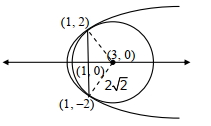
Answer

Correct option: B.
$\mathrm{C}_1$ and $\mathrm{C}_2$ touch each other exactly at two points
b
The circle and the parabola touch each other at $x=1$ $ei.e$. at the points $(1,2)$ and $(1,-2)$ as shown in the figure.

Need a full question paper?

Generate a complete, print-ready paper with questions like this in minutes — across 16+ boards, with answer keys.

Start Generating Free

Similar questions

Let $\quad \sum \limits_{n=0}^{\infty} \frac{n^3((2 n) !)+(2 n-1)(n !)}{(n !)((2 n) !)}=a e+\frac{b}{e}+c$, where $a, b, c \in Z$ and $e=\sum \limits_{n=0}^{\infty} \frac{1}{n!}$ Then $a^2-b+c$ is equal to $................$.
$\mathop {{\rm{lim}}\,}\limits_{n \to \infty } \left[ {\frac{1}{{{n^2}}}{{\sec }^2}\frac{1}{{{n^2}}} + \frac{2}{{{n^2}}}{{\sec }^2}\frac{4}{{{n^2}}} + ..... + \frac{1}{n}{{\sec }^2}1} \right]$ equals
 
The value of $ 'a' $ so that the volume of parallelopiped formed by $i + aj + k,j + a\,k$ and $a\,i + k$ becomes minimum is
The area of the shorter region bounded by $|y| = 4\, -\, x^2$ and $|y| = 3x$ is given by $\left( {3K + \frac{1}{3}} \right)$ sq-unit where $K$ is equal to
Consider a sequence whose sum of first $n$ -terms is given by $S_n = 4n^2 + 6n, n \in N$, then $T_{15}$ of this sequence is -
Let $\mathrm{a}$ and $\mathrm{b}$ be real constants such that the function $f$ defined by $f(x)=\left\{\begin{array}{cc}x^2+3 x+a & x \leq 1 \\ b x+2, & x>1\end{array}\right.$ be differentiable on $R$. Then, the value of $\int_{-2}^2 f(x) d x$ equals
If $A$ is a $3 \times 3$ matrix and $| A |=2$, then $\left|3 \operatorname{adj}\left(|3 A| A^2\right)\right|$ is equal to $.........$.
The value of $\mathop {\lim }\limits_{x \to 0} \frac{{\log [1 + {x^3}]}}{{{{\sin }^3}x}} = $
Let $f(x) = \left\{ {\begin{array}{*{20}{c}}{|x|,\,0 < \,|x|\, \le 2}\\{\,\,1\,\,\,,\,\,x = 0\,\,\,\,\,\,\,\,\,}\end{array}} \right.$, then at $x = 0$ $f$ has
If ${p^{th}},\;{q^{th}},\;{r^{th}}$ and ${s^{th}}$ terms of an $A.P.$ be in $G.P.$, then $(p - q),\;(q - r),\;(r - s)$ will be in