MCQ
Consider three converging lenses $L_1, L_2$ and $L_3$ having identical geometrical construction. The index of refraction of $\mathrm{L}_1$ and $\mathrm{L}_2$ are $\mu_1$ and $\mu_2$ respectively. The upper half of the lens $\mathrm{L}_3$ has a refractive index $\mu_1$ and the lower half has $\mu_2$. A point object $O$ is imaged at $O_1$ by the lens $L_1$ and at $O_2$ by the lens $L_2$ placed in same position. If $L_3$ is placed at the same place:
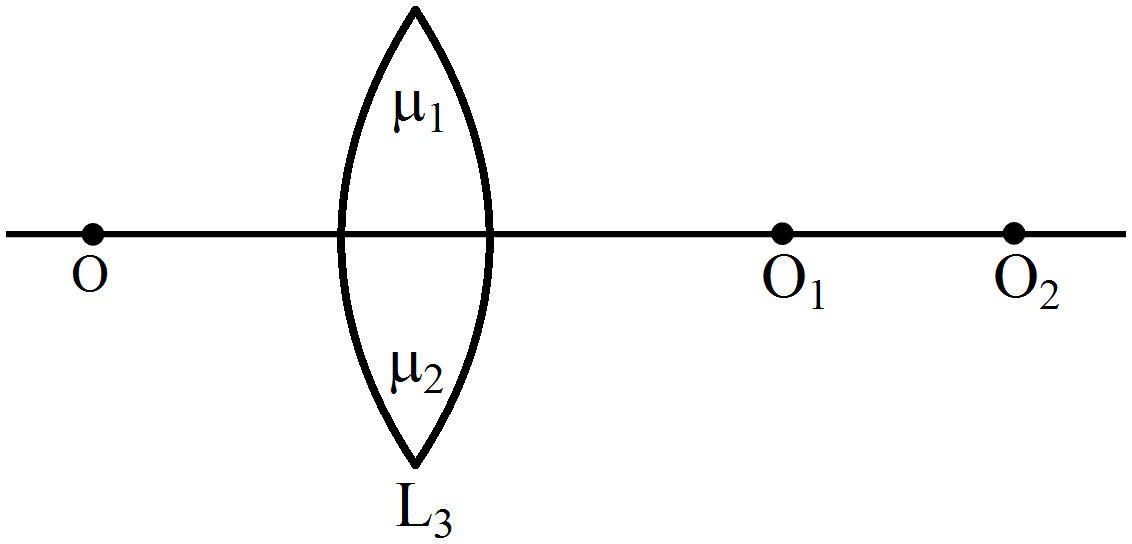
  • A
    There will be an image at $\mathrm{O}_1$
  • B
    There will be an image at $\mathrm{O}_2$
  • Both $A$ and $B$
  • D
    The only image will form away from $\mathrm{O}_2$.
Answer

Correct option: C.
Both $A$ and $B$

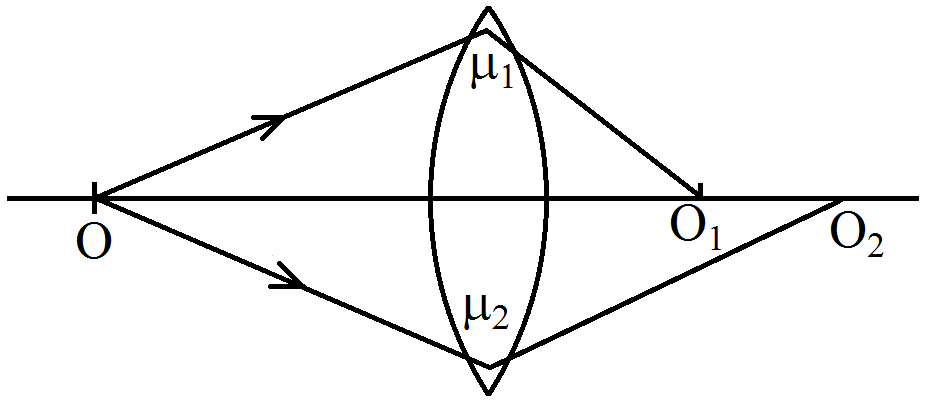
It rays are Passing through $\mathrm{m}_1$ then Image will be form at $"\mathrm{O}_1"$ and If rays are Passing through $\mathrm{m}_2$ then Image will be form at $"\mathrm{O}_2".$

Need a full question paper?

Generate a complete, print-ready paper with questions like this in minutes — across 16+ boards, with answer keys.

Start Generating Free

Similar questions

Two thermometers $X$ and $Y$ have ice points marked at $15^o$ and $25^o$ and steam points marked as $75^o$ and $125^o$ respectively. When thermometer $X$ measures the temperature of a bath as $60^o$ on it, what would thermometer $Y$ read  when it is used to measure the temperature of the same bath ? ...... $^o$
An ideal gas filled in a cylinder occupies volume $V$. The gas is compressed isothermally to the volume $V/3$. Now, the cylinder valve is opened and the gas is allowed to leak keeping temperature same. What percentage of the number of molecules should escape to bring the pressure in the cylinder back to its original value?
Kepler's third law states that square of period of revolution $(T)$ of a planet around the sun, is proportional to third power of average distance $r$ between sun and planet i.e.

$\therefore \;{T^2} = k{r^3}$

here $K$ is constant.

If the masses of sun and planet are $M$ and $m$ respectively then as per Newton's law of gravitation force of attraction between them is $F = \frac{{GMm}}{{{r^2}}}$ , here $G$ gravitational constant . The relation between $G$ and $K$ is described as

A gas is compressed at a constant pressure of $50N/{m^2}$ from a volume of $10{m^3}$ to a volume of $4{m^3}$. Energy of $100 J$ then added to the gas by heating. Its internal energy is
You measure two quantities as $\text{A} = 1.0 \text{m}\pm 0.2 \text{m},\ \text{B} = 2.0 \text{m}\pm 0.2 \text{m}.$ We should report correct value for $\sqrt{\text{AB}}$ as:
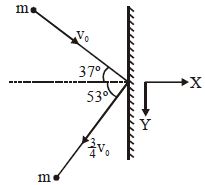
A ball of mass $m$ moving with velocity $v_0$ collides a wall as shown in figure. After impact it rebounds with a velocity $\frac {3}{4}v_0$. The impulse acting on ball during impact is
The resultant of two forces $3P$ and $2P$ is $R$. If the first force is doubled then the resultant is also doubled. The angle between the two forces is  ........... $^o$
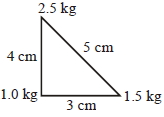
Three point particles of masses $1.0\; \mathrm{kg} .1 .5 \;\mathrm{kg}$ and $2.5\; kg$ are placed at three comers of a right angle triangle of sides $4.0\; \mathrm{cm}, 3.0 \;\mathrm{cm}$ and $5.0\; \mathrm{cm}$ as shown in the figure. The center of mass of the system is at a point
Abody performs simple harmonic oscillations along the straight line $ABCDE$ with $C$ as the midpoint of $AE.$ Its kinetic energies at $B$ and $D$ are each one fourth of its maximum value. If $AE = 2R,$ the distance between $B$ and $D$ is
Ten one-rupeed coins are put on top of each other on a table. Each coin has mass $m$. The reaction of the $6^{th}$ coin (counted from the bottom) on the $7^{th}$ coins is .......... $mg$