MCQ
Consider three points $\mathrm{P}=(-\sin (\beta-\alpha),-\cos \beta), \mathrm{Q}=(\cos (\beta-\alpha), \sin \beta)$ and $\mathrm{R}=(\cos (\beta-\alpha+\theta), \sin (\beta-\theta))$, where $0<$ $\alpha, \beta, \theta<\frac{\pi}{4}$. Then
  • A
    $\mathrm{P}$ lies on the line segment $\mathrm{RQ}$
  • B
    $\mathrm{Q}$ lies on the line segment $\mathrm{PR}$
  • C
    $\mathrm{R}$ lies on the line segment $\mathrm{QP}$
  • $\mathrm{P}, \mathrm{Q}, \mathrm{R}$ are non-collinear
Answer

Correct option: D.
$\mathrm{P}, \mathrm{Q}, \mathrm{R}$ are non-collinear
d
$ P \equiv(-\sin (\beta-\alpha),-\cos \beta) \equiv\left(x_1, y_1\right) $

$ Q \equiv(\cos (\beta-\alpha), \sin \beta) \equiv\left(x_2, y_2\right) $

$ \text { and } R \equiv\left(x_2 \cos \theta+x_1 \sin \theta, y_2 \cos \theta+y_1 \sin \theta\right) $

$ \text { We see that } T \equiv\left(\frac{x_2 \cos \theta+x_1 \sin \theta}{\cos \theta+\sin \theta}, \frac{y_2 \cos \theta+y_1 \sin \theta}{\cos \theta+\sin \theta}\right)$

We see that $\mathrm{T} \equiv\left(\frac{\mathrm{x}_2 \cos \theta+\mathrm{x}_1 \sin \theta}{\cos \theta+\sin \theta}, \frac{\mathrm{y}_2 \cos \theta+\mathrm{y}_1 \sin \theta}{\cos \theta+\sin \theta}\right)$

and $\mathrm{P}, \mathrm{Q}, \mathrm{T}$ are collinear $\Rightarrow P, Q, R$ are non-collinear.

Need a full question paper?

Generate a complete, print-ready paper with questions like this in minutes — across 16+ boards, with answer keys.

Start Generating Free

Similar questions

If $\tan\alpha=\frac{1-\cos\beta}{\sin\beta},$ then:
If  the number of terms in the expansion  of ${\left( {1 - \frac{2}{x} + \frac{4}{{{x^2}}}} \right)^n},x \ne 0$ is $28$ then the sum of the coefficients of all the terms in this expansion, is :
If $\text{f(x)}=\cos(\log\text{x}),$ then value of $\text{f(x)}\text{f(4)}-\frac{1}{2}\Big\{\text{f}\Big(\frac{\text{x}}{4}\Big)+\text{f}(4\text{x})\Big\}$ is:
Equation of the hyperbola whose vertices are $( \pm 3,0)$ and foci at $( \pm 5,0)$, is
 
If $P \equiv \left( {\frac{1}{{{x_p}}}\,\,,\,\,p} \right) ; Q = \left( {\frac{1}{{{x_q}}}\,\,,\,\,q} \right) ; R =\left( {\frac{1}{{{x_r}}}\,\,,\,\,r} \right)$ where $x_k \ne 0,$ denotes the $k^{th}$ term of an $H.P.$ for $k \in N,$ then :
If $−5\leq\frac{5 – 3\text{x}}{2}\leq8, $ then $\text{x}\in$
The length of the perpendicular from the point $(b,a)$to the line $\frac{x}{a} - \frac{y}{b} = 1$, is
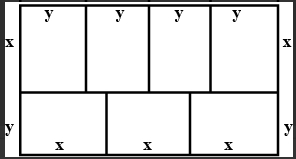
In the figure given below, a rectangle of perimeter $76$ units is divided into $7$ congruent rectangles.What is the perimeter of each of the smaller rectangles?
$7^{2 n}+3^{n-1} \cdot 2^{3 n-3}$ is divisible by:
Let $z_k=\cos \left(\frac{2 k \pi}{10}\right)+ i \sin \left(\frac{2 k \pi}{10}\right) ; k =1,2, \ldots 9$.

List $I$ List $II$
$P.$ For each $z_k$ there exists a $z_j$ such that $z_k \cdot z_j=1$ $1.$ True
$Q.$ There exists a $k \in\{1,2, \ldots ., 9\}$ such that $z_{1 .} . z=z_k$ has no solution $z$ in the set of complex numbers. $2.$ False
$R.$ $\frac{\left|1-z_1\right|\left|1-z_2\right| \ldots . .\left|1-z_9\right|}{10}$ equals $3.$ $1$
$S.$ $1-\sum_{k=1}^9 \cos \left(\frac{2 k \pi}{10}\right)$ equals $4.$ $2$

Codes: $ \quad P \quad Q \quad R \quad S$