MCQ
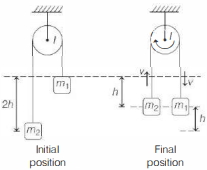
Consider two masses with $m_1 > m_2$ connected by a light inextensible string that passes over a pulley of radius $R$ and moment of inertia $I$ about its axis of rotation. The string does not slip on the pulley and  the pulley turns without friction. The two masses are released from rest separated by a vertical distance $2 h$. When the two masses pass each other, the speed of the masses is proportional to
  • $\sqrt{\frac{m_1-m_2}{m_1+m_2+\frac{I}{R^2}}}$
  • B
    $\sqrt{\frac{\left(m_1+m_2\right)\left(m_1-m_2\right)}{m_1+m_2+\frac{1}{R^2}}}$
  • C
    $\sqrt{\frac{m_1+m_2+\frac{I}{R^2}}{m_1-m_2}}$
  • D
    $\sqrt{\frac{1}{R^2}}$

Answer

Correct option: A.
$\sqrt{\frac{m_1-m_2}{m_1+m_2+\frac{I}{R^2}}}$
a
(a) Loss of potential energy of $m_1$ appears as kinetic energies of $m_1, m_2$ and pulley and also as potential energies of $m_1$ and $m_2$. So, by energy conservation, we get

$m_1 g h=\frac{1}{2} m_1 v^2+\frac{1}{2} m_2 v^2+\frac{1}{2} I \omega^2+m_2 g h$

Here, $m_1$ falls by distance $h, m_2$ rises by distance $h , v=$ speed of $m_1=$ speed of $m_2$ as they passes each other and $\omega=$ angular speed of pulley $=\frac{v}{R}$.

$\text { So, }\left(m_1-m_2\right) g h=\frac{v^2}{2}\left(m_1+m_2+\frac{I}{R^2}\right)$

$\therefore \quad v=\frac{2 g h\left(m_1-m_2\right)}{\left(m_1+m_2+\frac{I}{R^2}\right)}$

$\text { or } \quad v \propto \sqrt{\left(\frac{m_1-m_2}{m_1+m_2}+\frac{I}{R^2}\right)}$

Need a full question paper?

Generate a complete, print-ready paper with questions like this in minutes — across 16+ boards, with answer keys.

Start Generating Free

Similar questions

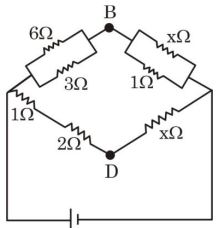
If the potential difference between $B$ and $D$ is zero, the value of $x$ is $\frac{1}{n} \Omega$. The value of $n$ is .......
A step-up transformer operates on a $230\, V$ line and supplies a load of $2$ $ampere$. The ratio of the primary and secondary windings is $1 : 25$. The current in the primary is....$A$
Mode of transmission of heat, in which heat is carried by the moving particles, is
Which reaction is not part of proton-proton cycle
A cell of internal resistance $r$ is connected across an external resistance $n r$. Then the ratio of the terminal voltage to the emf of the cell is
Four spheres $A, B, C$ and $D$ are of same radius but made of different metals. Their densities are in ratio $6 : 3 : 4 : 5$ and specific heats are in ratio $2 : 5 : 4 : 6$ . These are initially kept at the same temperature and placed in the same surroundings. The sphere which has the slowest rate of cooling is
An electron (charge $= 1.6 × 10^{-19}$ coulomb) is moving in a circle of radius $5.1 × 10^{-11}\,m$ at a frequency of $6.8 × 10^{15} $ revolutions/sec. The equivalent current is approximately
If ${E_a}$ be the electric field strength of a short dipole at a point on its axial line and ${E_e}$ that on the equatorial line at the same distance, then
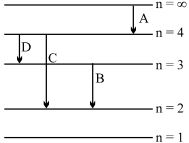
Consider the following electronic energy level diagram of $H-$ atom: Photons associated with shortest and longest wavelengths would be emitted from the atom by the transitions labelled:
Two identical capacitors, have the same capacitance $C$. One of them is charged to potential $V_1$ and the other to $V_2$. The negative ends of the capacitors are connected together. When the positive ends are also connected, the decrease in energy of the combined system is