Question
Consider two physical quantities A and B related to each other as $E=\frac{B-x^2}{A t}$ where $E, x$ and $t$ have dimensions of energy, length and time respectively. The dimension of $A B$ is

Answer

${[B]=L^2}$

$A=\frac{x^2}{t E}=\frac{L^2}{T^2 T^{-2}}=\frac{1}{M^{-1}}$

${[A]=M^{-1} T}$

${[A B]=\left[L^2 M^{-1} T^1\right]}$

Need a full question paper?

Generate a complete, print-ready paper with questions like this in minutes — across 16+ boards, with answer keys.
Start Generating Free

Similar questions

The condition for a uniform spherical mass $m$ of radius $r$ to be a black hole is [$G=$ gravitational constant and $g=$ acceleration due to gravity]
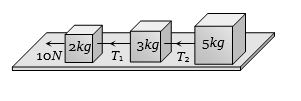
Three blocks of masses $2 \,kg, 3 \,kg$ and $5\, kg$ are connected to each other with light string and are then placed on a frictionless surface as shown in the figure. The system is pulled by a force $F = 10N,$ then tension ${T_1} = $  .......... $N$ 
Two satellites of mass $50\,kg$ and $100\,kg$ revolve around the earth in circular orbit of radius $9\,R$ and $16\,R$ respectively, where $R$ is the radius of earth. The speeds of the two satellites will be in the ratio
Two particles $A$ and $B$ initially at rest move towards each other under a mutual force  of attraction. At the instant when velocity of $A$ is $v$ and that of $B$ is $2v$, the velocity of centre  of mass of the system is
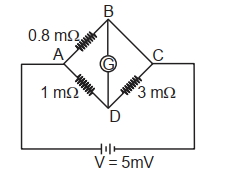
To measure the temperature coefficient of resistivity $\alpha$ of a semiconductor, an electrical arrangement shown in the figure is prepared. The arm BC is made up of the semiconductor. The experiment is being conducted at $25^{\circ} \mathrm{C}$ and resistance of the semiconductor arm is $3 \mathrm{~m} \Omega$. Arm BC is cooled at a constant rate of $2^{\circ} \mathrm{C} / \mathrm{s}$. If the galvanometer $\mathrm{G}$ shows no deflection after $10 \mathrm{~s}$, then $\alpha$ is :
The potential energy of a simple harmonic oscillator of mass $2\, kg$ in its mean position is $5\, J.$ If its total energy is $9\,J$ and its amplitude is $0.01\, m,$ its time period would be
The graph of pressure $(P)$ and volume $(V)$ according to $PV^n = C$, here $n = 1.4$
The equation of a transverse wave is given by $y = 100\,\sin \pi (0.04z - 2t)$ where $y$ and $z$ are in $cm$ and $t$ is in seconds. The frequency of the wave in $Hz$ is
If the overbridge is concave instead of being convex, the thrust on the road at the lowest position will be
The speed of a body moving with uniform acceleration is $u$. This speed is doubled while covering a distance $S$. When it covers an additional distance $S$, its speed would become