MCQ
Consider two processes on a system as shown in figure.
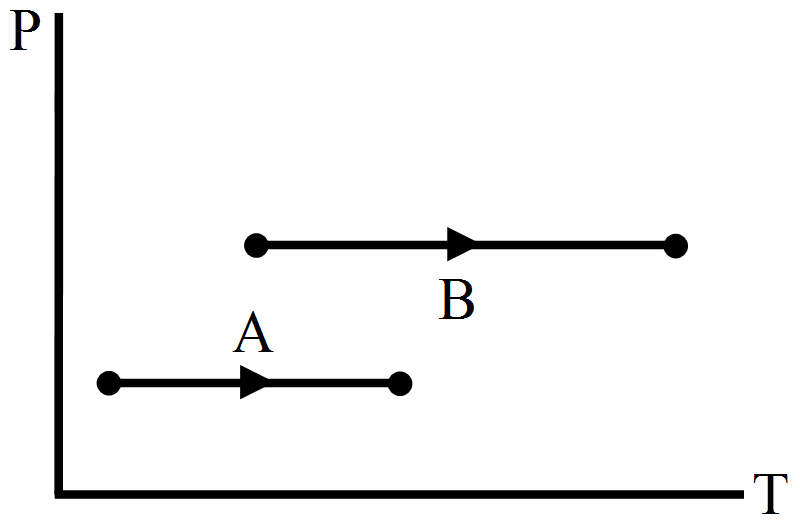
The volumes in the initial states are the same in the two processes and the volumes in the final states are also the same. Let $\Delta\text{W}_1$ and $\Delta\text{W}_2$ be the work done by the system in the processes $A$ and $B$ respectively.
  • A
    $\Delta\text{W}_1>\Delta\text{W}_2.$
  • B
    $\Delta\text{W}_1=\Delta\text{W}_2.$
  • $\Delta\text{W}_1<\Delta\text{W}_2.$
  • D
    Nothing can be said about the relation between $\Delta\text{W}_1$ and $\Delta\text{W}_2.$

Answer

Correct option: C.
$\Delta\text{W}_1<\Delta\text{W}_2.$
Work done by the system, $\Delta\text{W}=\text{P}\Delta\text{V}$
Here,
$P =$ Pressure in the process
$\Delta\text{V} =$ Change in volume during the process
Let $\text{V}_{\text{i}}$ and $\text{V}_{\text{f}}$​ be the volumes in the initial states and final states for processes $A$ and $B,$ respectively. Then,
$\Delta\text{W}_1=\text{P}_1\Delta\text{V}_1$
$\Delta\text{W}_2=\text{P}_2\Delta\text{V}_2$
But $\Delta\text{V}_2=\Delta\text{V}_1,$ $\big[(\text{V}_{\text{f}_1}-\text{V}_{\text{i}_1})=(\text{V}_{\text{f}_2}-\text{V}_{\text{i}_2})\big]$
$\Rightarrow\frac{\Delta\text{W}_1}{\Delta\text{W}_2}=\frac{\text{P}_1}{\text{P}_2}$
$\Rightarrow\Delta\text{W}_1<\Delta\text{W}_2\ [\because\text{P}_2>\text{P}_1]$

Need a full question paper?

Generate a complete, print-ready paper with questions like this in minutes — across 16+ boards, with answer keys.

Start Generating Free

Similar questions

A Carnot engine has efficiency $25\%$ . It operates between reservoirs of constant temperature with temperature difference of $80\,K$ . What is the temperature of low temperature reservoir ...... $^oC$
In a head on elastic collision of a very heavy body moving with velocity $v$ with a light body at rest. Then, the velocity of heavy body after collision is:
A particle moves in the $X - Y$ plane according to the equation $\overrightarrow{\text{r}}=\Big(\overrightarrow{\text{i}}+2\overrightarrow{\text{j}}\Big)\text{A}\cos\omega\text{t}.$ The motion of the particle is:
A rubber ball is taken to a $100\, m$ deep lake and its volume changes by $0.1\%$. The bulk modulus of rubber is nearly
The maximum acceleration of a particle in $SHM$ is made two times keeping the maximum speed to be constant. It is possible when
A steel meter scale is to be ruled so that millimeter intervals are accurate within about $5 \times 10^{-5}$ $mm$ at a certain temperature. The maximum temperature variation allowable during the ruling is .......... $^oC$  (Coefficient of linear expansion of steel $ = 10 \times {10^{ - 6}}{K^{ - 1}})$
The displacement of a particle in string stretched in $X$ direction is represented by $y.$ Among the following expressions for $y,$ those describing wave motions are
If for two vector $\overrightarrow A $ and $\overrightarrow B $, sum $(\overrightarrow A + \overrightarrow B )$ is perpendicular to the difference $(\overrightarrow A - \overrightarrow B )$. The ratio of their magnitude is
According to kinetic theory of gases the $\text{r.m.s}.$ velocity of the gas molecules is directly proportional to:
A body falling from a height of $10\,m$ rebounds from hard floor. If it loses $20\%$ energy on the impact, then coefficient of restitution is