Question
Consider two processes on a system as shown in figure.
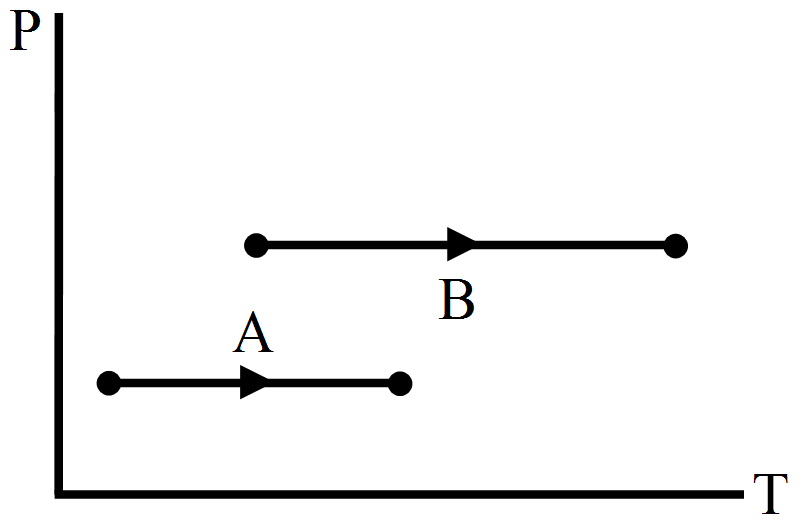
The volumes in the initial states are the same in the two processes and the volumes in the final states are also the same. Let $\Delta\text{W}_1$ and $\Delta\text{W}_2$ be the work done by the system in the processes A and B respectively.

  1. $\Delta\text{W}_1>\Delta\text{W}_2.$

  2. $\Delta\text{W}_1=\Delta\text{W}_2.$

  3. $\Delta\text{W}_1<\Delta\text{W}_2.$

  4. Nothing can be said about the relation between $\Delta\text{W}_1$ and $\Delta\text{W}_2.$
Answer

  1. $\Delta\text{W}_1<\Delta\text{W}_2.$

Explanation:

Work done by the system, $\Delta\text{W}=\text{P}\Delta\text{V}$

Here,

P = Pressure in the process

$\Delta\text{V}$ = Change in volume during the process

Let Vi and Vf​ be the volumes in the initial states and final states for processes A and B, respectively. Then,

$\Delta\text{W}_1=\text{P}_1\Delta\text{V}_1$

$\Delta\text{W}_2=\text{P}_2\Delta\text{V}_2$

But $\Delta\text{V}_2=\Delta\text{V}_1,$ $\big[(\text{V}_{\text{f}_1}-\text{V}_{\text{i}_1})=(\text{V}_{\text{f}_2}-\text{V}_{\text{i}_2})\big]$

$\Rightarrow\frac{\Delta\text{W}_1}{\Delta\text{W}_2}=\frac{\text{P}_1}{\text{P}_2}$

$\Rightarrow\Delta\text{W}_1<\Delta\text{W}_2\ [\because\text{P}_2>\text{P}_1]$

Need a full question paper?

Generate a complete, print-ready paper with questions like this in minutes — across 16+ boards, with answer keys.

Start Generating Free

Similar questions

For which of the following does the centre of mass lie outside the body?
  1. A pencil
  2. A shotput
  3. A dice
  4. A bangle
A progressive wave travelling in positive by $x-$ direction given by $y = a\, sin (kx -\omega t)$ meets fixed end at $x = 0$. The reflected wave may be given by
A molecule in a gas container hits a horizontal wall with speed 200ms-2 and angle 30° with the normal and rebounds with the same speed. Which statement is true?
A mass m is suspended from a spring of length l and force constant $K$. The frequency of vibration of the mass is ${f_1}$. The spring is cut into two equal parts and the same mass is suspended from one of the parts. The new frequency of vibration of mass is ${f_2}$. Which of the following relations between the frequencies is correct
Two solids $A$  and $ B$  float in water. It is observed that $A$  floats with $\frac{1}{2}$ of its body immersed in water and $ B$  floats with $\frac{1}{4}$ of its volume above the water level. The ratio of the density of $ A$  to that of $B$  is
A man of weight $80\, kg$ is standing in an elevator which is moving with an acceleration of $6\,\,m/{s^2}$ in upward direction. The apparent weight of the man will be  ......... $N$ $(g = 10\,m/{s^2})$
A plank with a box on it at one end is gradually raised about the other end. As the angle of inclination with the horizontal reaches $30^o$, the box starts to slip and slides $4.0\, m$ down the plank in $4.0\,s$. The coefficients of static and kinetic friction between the box and the plank will be, respectively
The figure shows a man of mass $m$ standing at the end $A$ of a trolley of mass $M$ placed at rest on a smooth horizontal surface. The man starts moving towards the end $B$ with a velocity $u_{rel}$ with respect to the trolley. The length of the trolley is $L$. When the man starts moving, then the velocity of the trolley $v_2$ with respect to ground will be
A sine wave has an amplitude $A$ and wavelength $\lambda$. Let $V$ be the wave velocity and $v$ be the maximum velocity of a particle in the medium. Then 
$A$ ball whose size is slightly smaller than width of the tube of radius $2.5 \,m$ is projected from bottommost point of a smooth tube fixed in a vertical plane with velocity of $10\, m/s$. If $N_1$ and $N_2$ are the normal reactions exerted by inner side and outer side of the tube on the ball