MCQ
Consider two sound sources $S_1$ and $s_2$ having same frequency $100\,\,Hz$ and the observer $O$ located between them as shown in the fig. All the three are moving with same velocity in same direction. The beat frequency of the observer is .... $Hz$

  • A
    $50$
  • B
    $5$
  • $0$
  • D
    $2.5$

Answer

Correct option: C.
$0$
c

Need a full question paper?

Generate a complete, print-ready paper with questions like this in minutes — across 16+ boards, with answer keys.

Start Generating Free

Similar questions

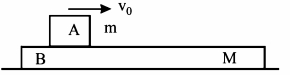
The masses of blocks A and B are $m$ and $M$ respectively. Between $A$ and $B$, there is a constant frictional force $F$ and $B$ can slide on a smooth horizontal surface. A is set in motion with velocity while $B$ is at rest. What is the distance moved by A relative to $B$ before they move with the same velocity?
Two bodies are held separated by $9.8\,m$ vertically one above the other. They are released simultaneously to fall freely under gravity. After $2\,s$, the relative distance between them is $............\,m$
If a solid sphere of mass $1\, kg$ and radius $0.1\, m$ rolls without slipping at a uniform velocity of $1\, m/s$ along a straight line on a horizontal floor, the kinetic energy is
If a body is thrown up with the velocity of $15 \,m/s$ then maximum height attained by the body is..........$m$ ($g = 10\,m/{s^2}$)
Pressure is applied to an enclosed fluid. It is:
If acceleration due to gravity at distance $d[ < R]$ from the centre of earth is $\beta$, then its value at distance $d$ above the surface of earth will be [where $R$ is radius of earth]
A source of sound and listener are approaching each other with a speed of $40 m/s.$ The apparent frequency of note produced by the source is $400 \,cps$. Then, its true frequency (in $cps$) is (velocity of sound in air $= 360 m/s$)
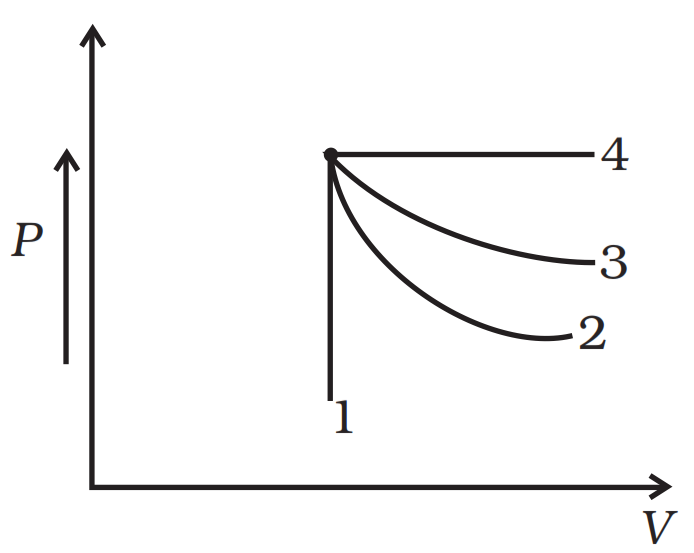
An ideal gas undergoes four different processes from thesame initial state $($Fig.$)$. Four processes are adiabatic, isothermal, isobaric and isochoric. Out of $1, 2, 3$ and $4$ whichone is adiabatic.
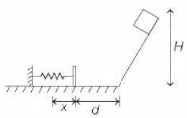
A block of mass $m$ slides from rest at a height $H$ on a frictionless inclined plane as shown in the figure. It travels a distance $d$ across a rough horizontal surface with coefficient of kinetic friction $\mu$ and compresses a spring of spring constant $k$ by a distance $x$ before coming to rest momentarily. Then the spring extends and the block travels back attaining a final height of $h$. Then,
A body is moving with velocity $1\ m/ s$ at a height $3m$ from the ground. What will be its speed at height $2m$ from the ground?