MCQ
Consider two statements A and B given below:
  1. Real image is always inverted.
  2. Virtual image is always erect.
Out of these two statements:
  • A
    Only A is true.
  • B
    Only B is true.
  • C
    Both A and B are true.
  • D
    None is true.

Answer

  1. Both A and B are true.

Explanation:

A real image is always inverted and a virtual image is always erect.

Need a full question paper?

Generate a complete, print-ready paper with questions like this in minutes — across 16+ boards, with answer keys.

Start Generating Free

Similar questions

The red colour of the sun at the time of sunrise and sunset is because:
  1. Red colour is least scattered.
  2. Blue colour is least scattered.
  3. Red colour is most scattered.
  4. Blue colour is most scattered.
In order to obtain a magnification of, -3 (minus 3) with a convex lens, the object should be placed:
  1. Between optical centre and F.
  2. Between F and 2F.
  3. At 2F.
  4. Beyond 2F.
Which of the following colour of white light has the least wavelength?
  1. Red.
  2. Orange.
  3. Violet.
  4. Blue.
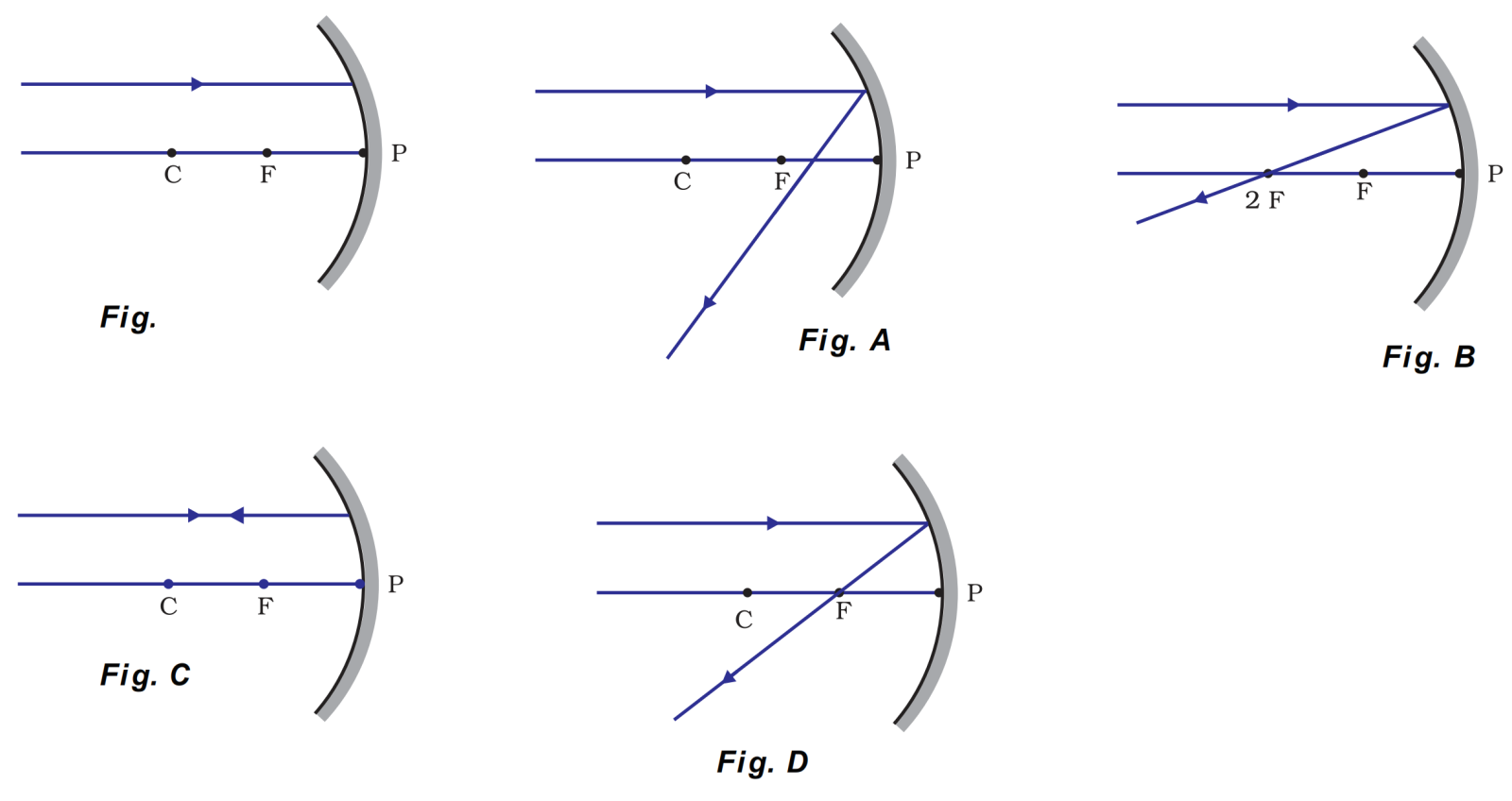
Which of the following ray diagrams is correct for the ray of light incident on a concave mirror as shown in Figure?
Due to atmospheric refraction of sunlight, the time from sunrise to sunset is lengthened by about:
  1. 6 minutes.
  2. 2 minutes.
  3. 4 minutes.
  4. 5 minutes.
A TV set consumes an electric power of 230 watts and runs on 230 volts mains supply. The correct fuse for this TV set is:
  1. 5A
  2. 3A
  3. 1A
  4. 2A
Due to atmospheric refraction of sunlight, the time from sunrise to sunset is lengthened by about:
  1. 6 minutes.
  2. 2 minute..
  3. 4 minutes.
  4. 5 minutes.
Refractive indices of water, sulphuric acid, glass and carbon disulphide are 1.33, 1.43, 1.53 and 1.63 respectively. the light travels slowest in:
  1. Sulphuric acid.
  2. Glass.
  3. Water.
  4. Carbon disulphide.
Rays from Sun converge at a point 15cm in front of a concave mirror. Where should an object be placed so that size of its image is equal to the size of the object?
  1. 15cm in front of the mirror.
  2. 30cm in front of the mirror.
  3. Between 15cm and 30cm in front of the mirror.
  4. More than 30cm in front of the mirror.
For finding the focal length of a convex lens by obtaining the image of a distant object, one should use as the object: